Every month, I have to think up what I’m going to write for my Musings blog post, and I know what you’re thinking. “Well, do you have to?” Well, no. Nobody’s putting a gun to my head. But it’s a commitment I have made, and I have learned that you cannot keep your promises to other people if you don’t keep your promises to yourself.
I started this blog Monique’s Musings because as a writer, I love to engage and share my thoughts but I know I won’t always be invited to do so, and that means I needed to create a space for me to do that regularly so I practice my craft. And as I’ve said before, it is hard to maintain a practice for over a decade. But even if I have not posted every month for a decade, I have posted nearly every month for a decade, and of that I’m very proud. It’s a way to ensure that I continue writing, and that I continue engaging with a wider audience in a way that is not academic. It doesn’t pay me, but it shows that even if I wasn’t paid, I would still write. That’s what makes me a writer. Even if I’m not given a platform, I can create one for myself and talk about what I want.
Well, thinking of a topic to write about every month is hard. Let me not lie. And I know it’s entitled My Musings, but as an overthinker, that actually makes it harder, because as an overthinker, I muse about a million different things a day. So deciding which one I’m going to write about, and how I’m going to extrapolate it into a comprehensive blog post that is worth putting out there, is a bit difficult.
This month was one of those months when I have been like, “What the hell am I going to write about?” Not because I don’t have a topic. I do. But which of them can I really say I want to discuss now, and properly deliberate on? So instead, I’m going to give a rundown of what my musings have been this month, the discussion I want us to have. And as I’ve sat with them, I’ve realised these underdeveloped threads of musings are not separate. One leads to the next, and each feeds into the other. So bear with me as I follow the thread. And if you’re reading, I hope the discussion goes far with you.
“But what about men?”
November is the month that holds International Men’s Day. Earlier this year, during Women’s Month, I ran a campaign where I answered a question about feminism every day of the month. I compiled those answers, and they are available on my YouTube channel. One of the recurrent questions was: “You focus only on women. What about men? People don’t give attention to men.” I addressed that question during the campaign in March. But as the 19th of November is International Men’s Day, and I will admit it’s not recognised as much as IWD, the question comes up again at this time of the year.
And what I’m musing on is this: it always comes up as if it’s a rebuttal to feminist work for women. It’s always like a competition, rather than that they actually care about men. Men expect us to fight for them even while we’re fighting for ourselves. Apparently it’s our fault that International Men’s Day is not celebrated, even though it’s also our fault that International Women’s Day is over-celebrated. Funny how nobody ever blames the men for anything. It’s not their fault for anything. They don’t take responsibility for any of it.
International Women’s Day was fought for. People sacrificed for it to be what it is today, and I’m not even proud of what it is today. We have gone from a day that commemorates gender equity and the fight for social justice to a party, a fête, and that is something I’ve complained about severally. But now men are like, “Oh, we want our own fête.” They have seen the fête, the part that is not even supposed to be good, the part that is actually a deterioration of the commemoration, and they’re like, “But we are not getting celebrated too. Men are not receiving any gifts.” And I’m just like, “What?”
Here’s what I want to problematise. In Cameroon, for example, more men lead civil society organisations than women. Men are predominantly at the top of the multilateral organisations that have the power to fund events around International Men’s Day. But they don’t. So why are we attacking women for not celebrating International Men’s Day? Why are we not going to all the men running civil society organisations and asking them why they didn’t commemorate International Men’s Day properly? Why?
You guys could fight for yourselves. You could address the issues of men. But no, you would rather complain that the feminist movement is not doing more for men, even though you do not like the feminist movement. It’s a logical fallacy of some sort. It’s just complaining. It’s not genuine. It’s not authentic.
So let’s expect men to do more for themselves
Now, don’t get me wrong. Men have issues, and International Men’s Day is the day that we should bring up men’s issues, but not only on that day but throughout the year. Actually, I want to see more men talking about their issues, perhaps if they discuss it enough they’ll find that patriarchy is at the root, affecting them just as it does women. But I’m not going to be the one coerced into leading discussions about mens issues, they should be the ones centred in that. Similarly I’m not talking to men anymore about sexism.
It’s just like Reni Eddo-Lodge’s book, Why I’m No Longer Talking to White People About Race. I’m no longer talking to men about sexism. They know enough about it, they just don’t care enough until it hits close to home. It’s not like they do not know that sexism is a thing. It’s not like they do not know that inequality in our culture is a thing. It is that they feel like, “Oh yeah, inequality is a thing, but let’s not take it too far.” And by “too far,” they mean, “Let’s not get to where I am uncomfortable.”
I know that they know because whenever you tell them, “Oh, you act like a woman,” they get offended. So they know that being called a woman is not a compliment. They know because they understand consent and rape when it concerns male molestation in prison. It’s a threat: “Oh, don’t bend over in prison, they will do you.” Who will do you? They know their friends make rape jokes, so they don’t allow their sisters next to them.
I’ve said this before, but there was a certain period when “men are trash” was trending, and men were like, “Oh, is your father trash as well?” And a lot of women responded, “Yes, that’s why I know men are trash.” Or they would say, “The first person to tell me that men are trash was actually my father.” They told us men are trash when they said, “Go and change your clothes because this person is coming.” “Oh, don’t talk to that friend of mine.” All the warnings they gave us about their fellow men told us that they couldn’t be trusted.
So I don’t think we need to convince men that inequality and women’s subordination is a thing. They complain that they are not appreciated and celebrated enough, but guess what? They won’t want to switch to experience women’s lives and oppression. So obviously they know who has it worse. Perhaps what needs to be done is to convince men that they can do this for themselves. And in a way, that’s what feminism is about. So let us actually expect men to do more for themselves. I trust men to do more for themselves. I believe in you. I literally do believe in you. You can be a better human being. I believe that men can organise in the same way women have over the years to make IWD the day that it is. It didn’t come easy for us. You have the resources.
So let’s not engage in the faux “gender war” any longer, there is no war. Let’s turn the light back on them and say: we believe in you, you should talk about this, you should address this. And the question for us becomes, how do we leave room for them to take the stage and do what needs to be done?
In place of that, talking to women about internalised sexism
So if I’m no longer spending my energy convincing men, where does that energy go? Rather than talking to men about sexism, I’m going to be doing a lot more talking to women about internalized sexism, because I’ve seen how much of a problem it is.
The Cameroonian women’s movement is unfortunately very divided, and there is this, I would say, nonsense belief, this stereotype, that women are their own worst enemies. That thing is so stupid, considering the fact that men have been causing wars all their lives and nobody ever said men are men’s worst enemies. But because of some catfight here and there, people are like, “Oh, you know, women are their own worst enemies.” No. Why is a small group of women fighting taken to represent the whole group, whereas men fighting is okay, it’s normal? You expect that women should be happy all the time and love each other all the time. They will fight. They are human. Humans can do good, or bad. But the action of one woman against another doesn’t represent the whole. Just as no one ever said men are their own worse enemies because Bruto did what he did to Caesar or countless other examples of men turning on fellow men.
Anyway, long story short, that internalized sexism has been competition. It’s the way we are raised to see each other as threats. Patriarchy, the system, has used that to pit us against each other for men’s favour. To pit us against each other to be the best girl, to get the prize, to get chosen for being the ideal woman, the superwoman, all of that, all of that.
I have come to hate internalized sexism even more than external sexism, because I am of the opinion that the water that sinks the ship comes from inside it. As much as we have these external pressures, the patriarchy and the structural sexism affecting us from outside, it wins. It succeeds because we have division within, because we have catfights within, because we have misunderstandings within.
So my idea, my approach right now, is to talk to other women. To make other women understand: you are not a threat to me, and I don’t really have an issue with you. We are going to fight, just like I will fight with my younger brother. It doesn’t mean that I hate him. It means that humans are humans, and me fighting with you does not disavow sisterhood. People are jealous of each other. I mean, Cain and Abel were men, and yet nobody talks about how man is man’s own worst enemy. But God forbid a woman had been the one to commit the first murder. Oh, we would never have heard the last of it.
More than one way to fight gender-based violence?
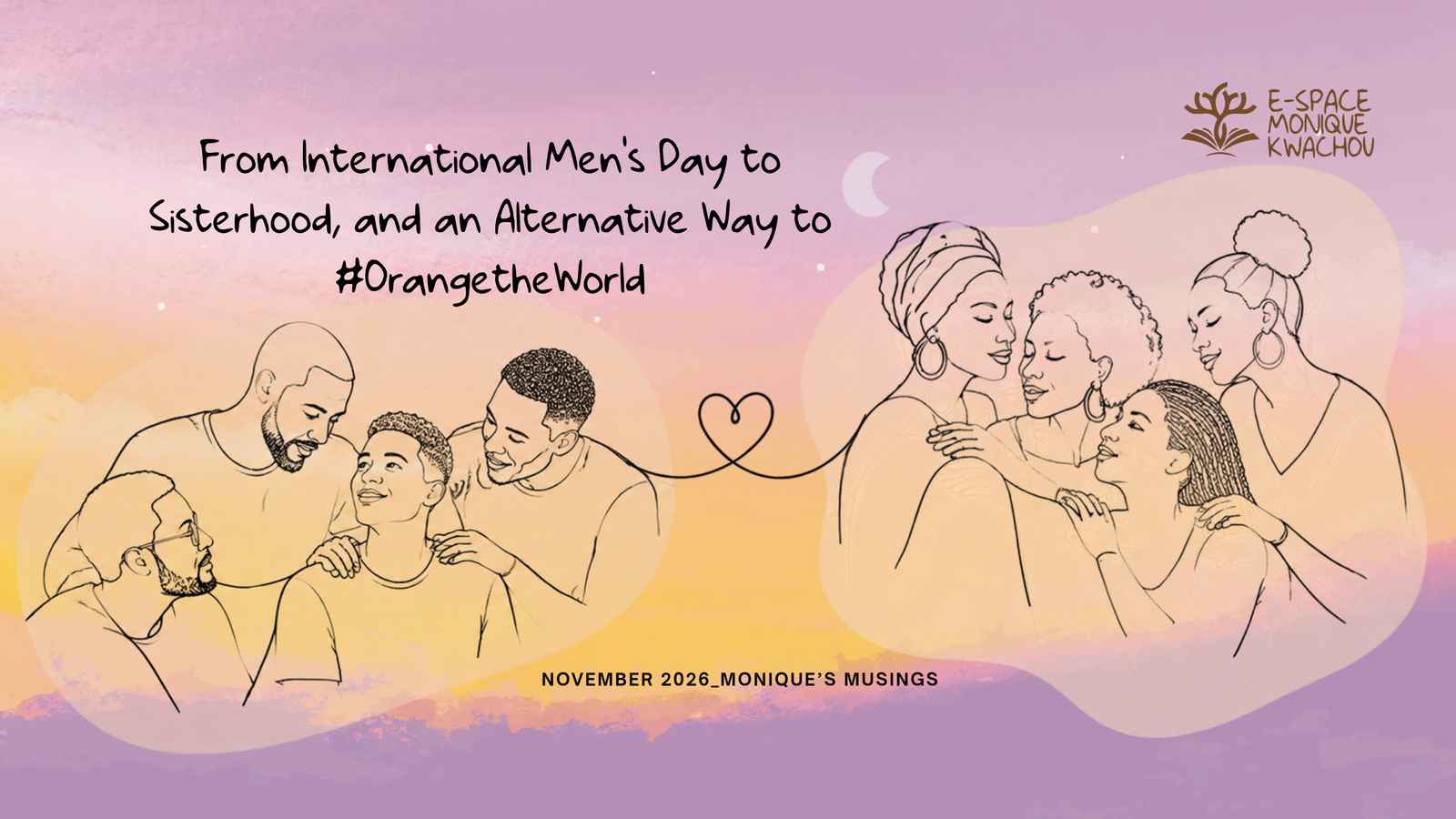
And this is where it all comes together for me. Typically, we talk about gender-based violence this month as well. Just a week after International Men’s Day, as of the 25th of November, the international campaign led by multilateral organisations “Orange the World, the 16 Days of Activism against Gender-Based Violence”, begins and you see renewed activity (similar to what is done in March) with institutions talking about gender-based violence and what we can do against it.
I’ve always felt off about the positioning of the campaign, but this year I feel even more so. I feel like we are wasting the potential of harnessing this period to put the spotlight on men as the key beneficiaries of patriarchy and perpetuators of gender-based violence. International Men’s Day should be more linked to this campaign. There’s so many ways to do so, For instance, what if International Men’s Day flowed into the 16 Days Campaign where we focus on addressing the toxic masculinity behind the gender based violence. Rather than having events centering women as victims, why not center men as perpetuators as well as under-reported victims and address the root of the issue?
But then, there are multiple ways, all of which are necessary, to combat this issue. As I’ve decided to pour more effort into addressing internalized sexism, I’m taking a different approach this year: Fighting GBV by strengthening the sisterhood. Because guess what? Girls with strong support systems, strong sisterhoods, get out of gender-based violence more than those who are isolated. The first strategy domestic violence abusers use is actually to isolate their victims. So if we were united, if we were confident in ourselves, we would be on guard against the threat.
So yeah, “Orange the World” Or better yet, I don’t know… which colour best represents female unity. Violet? Maybe we can use that then. Whatever it takes, whatever method we use, I hope we spend more time strengthening sisterhood and creating spaces for each other rather than waste time talking to men about violence they know very well. Perhaps take the challenge to say one good thing about the next woman for each of the subsequent 16 days.
Rather than appealing to men or turning their day to the currently fetishized version of IWD, lets turn the spotlight on them to address what they know is a problem and trust that they would. That frees us to turn to each other, to heal the divisions within, and to build the kind of sisterhood that keeps women out of isolation and out of harm’s way.
So that’s the thread of my musings this month.
Let me know what you think in the comments!