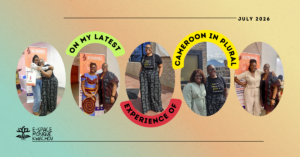
On My Latest Experience of Cameroon in Plural

In my research and in my writing, there is something I have gradually come to realize that we do a great disservice and an undermining of the complexity that is the Cameroonian experience when we simply frame Cameroon as “linguistically divided”; with that description, people often think that the division is simply about language, that when you cross from one region into another you are merely encountering the necessity of speaking a different language. But it isn’t only that; when one crosses from one linguistic space to another, it isn’t only language or even culture that change; one often encounters a different way of life, different conversations, and different realities altogether. Even commerce changes. Spend enough time moving around Cameroon, and you begin to notice that what people buy and even what is available in the markets differ from region to region. Merchants in the Anglophone regions have historically looked westwards. Goods often arrive from neighbouring Nigeria or through Cameroon’s diaspora community members shipping items from the UK, Germany, the United States and elsewhere. As a result, there are products that are commonplace in Bamenda, Buea or Kumba that you might struggle to find in Yaoundé or Bertoua. On the other hand, many Francophone merchants have traditionally sourced goods through commercial networks linked to Douala, France, Côte d’Ivoire and other Francophone countries. You therefore find brands, fashions, food items and consumer habits that feel completely familiar on one side of the country and almost foreign on the other. It is one of those quiet reminders that Cameroon is not simply divided by language; our networks have evolved in different directions as well. Similarly, our entertainment and social interests demonstrate the divide. Francophone Cameroon on Twitter is often completely different from Anglophone Cameroon on Twitter. The stories that are trending, the issues people are debating, and the ‘influencers’ who wield public attention are not the same. It is almost as though we inhabit parallel public spheres that occasionally intersect but often continue quite independently of one another. I have found the same thing in my work on women’s issues and the feminist movement in Cameroon. One of the things that has struck me repeatedly is that what has concerned feminist organisations in the Anglophone regions has not necessarily been what concerns feminist organisations in Francophone Cameroon. And even within Francophone Cameroon, if you move further north, you discover yet another reality. The issues occupying women’s organisations in the Far North are often quite different from those occupying organisations in the South. To me, this is one of the most intriguing things my research and practice have revealed over the years, and I’d argue, one of Cameroonian civil society’s greatest weaknesses. Any movement that is divided, whatever the basis of that division, inevitably weakens itself. We cannot really speak of a national movement if we each respond only to the concerns within our own linguistic, regional, or cultural spaces. I have been thinking about this a great deal in phases of sorts over the past years for different reasons. The first time I thought of this was following a personal evaluation. A few years ago, as I reflected on my years leading Better Breed Cameroon before moving to serve only on its Board, I found myself asking what I had done well, where I had succeeded, and where I had failed. One of the first shortcomings I identified was that I had not engaged Francophone Cameroon nearly enough. Looking back, I suspect that part of the reason was that I come from one of the country’s marginalised communities myself. My instinct was naturally to focus my energy there because there seemed to be more than enough work to do among people marginalised than the majority the system comparatively privileged. But I realise now that this was a strategic mistake. No matter how justified the reason may be, you cannot simply disconnect social change work from almost three-fifths of the country. If we are serious about creating systemic change, then we cannot afford to remain within our own regional conversations. That was one of the lessons I took away from that period of reflection, and it is one of the reasons I have become much more intentional about engaging Francophone Cameroon in recent years. The second phase of this reflection was first sown in my mind far earlier, during one of the very first consultancies I ever did. In 2021, I worked with Global Fund for Women on research exploring youth movements in Cameroon and the priorities of youth-led organisations across the country.What fascinated me was how different those priorities were depending on where the organisations were based. Many of the organisations in the South were prioritising peacebuilding, employment, entrepreneurship and economic opportunity. Organisations in the Far North, however, kept returning to something that, at first, I simply could not understand. Birth certificates. I remember wondering why obtaining a birth certificate had become the focus of entire initiatives. Surely this was something that happened automatically. Surely everyone had one. It was only as I continued researching that I began to understand: If you do not have a birth certificate, there is no official proof of your age. If there is no official proof of your age, then how do you establish that you were a minor when you were married off? If the law prohibits child marriage, to which court do you take a child who has no documentation proving that she was, in fact, a child? How do you prove that a crime has taken place when the very evidence required to establish it does not exist?The more I thought about it, the more I realised that a birth certificate is not just a birth certificate. Without one, obtaining a national identity card becomes almost impossible. Without a national identity card, you are technically in violation of the law because Cameroonian adults are required to carry identification. And anyone who has lived in Cameroon knows how often police officers use identity
Read More »

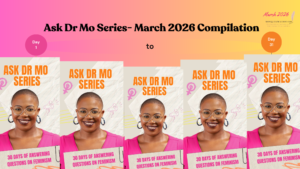
Ask Dr Mo Series- March 2026 Compilation

Throughout March 2026, I have been musing on and responding to a variety of feminism-related questions as part of a challenge from Lorraine Shu Media in commemoration of Women’s Month!If you missed following via my social media, here is a compilation embedded as a vlog. Links to AFF resources mentioned on day 30: English: https://share.google/fO8rVbCbkq6fxghTc French: https://wipc.org/wp-content/uploads/2020/03/The-African-Feminist-Charter-French.pdf

Read More »

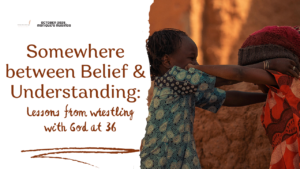
Somewhere between Belief & Understanding: Lessons from wrestling with God at 36

I recently completed my 36th turn around the sun and I would like to share what has been the lesson of this age for me. Before I begin though, I must preface this by saying that I believe in God. Belief aside, even my logic affirms that there is a God. Still, I acknowledge that the questions that follow; Who’s God? How good is God? etc. are valid, but the existence of a supreme being has never been in doubt for me. I’ve had personal encounters, a life filled with testimonies, and the reasoning that there is simply too much intricacy and beauty in creation for there not to be a divine being. I not only believe in God, I am a Christian. Some might argue that’s because I was born into a Christian family, and perhaps they’re partly right; maybe if I were born elsewhere, I’d have clung to another faith. But it isn’t my family that made me Christian. They set the stage, but it was my own encounter with God that sealed it. I gave my life to Christ after a suicide attempt, so my journey is deeply personal (read conversion story here). This year, however, has been one of the most trying for my faith. It has pushed me to wrestle with belief and logic in ways I hadn’t before. In earlier years, I’ve had doubts, yes, but they were mostly tied to depression, suicidal ideation, or difficult circumstances, not solely intellectual questioning. The last time I questioned God this deeply was in 2021, when suicidal thoughts resurfaced after years of dormancy. It was painful to want to die while watching others who wanted to live lose their lives. In 2022, things began to shift. Therapy and a strong Christian sisterhood helped me heal. That season led me to reaffirm my vows to Christ through baptism in August 2022. I wrote about here it at the time. My promise then was simple: Lord, I won’t attempt to take my life again. I’m surrendering the life to you who obviously wants to keep me here. Help me appreciate that, see value in being here and to live for You. Since then, my faith hasn’t been perfect, but it’s been steady, until recently. Between late 2024 and now, I’ve been shaken by what I’ve witnessed in the global Christian community, particularly the rise of American Christian nationalism. Because American culture dominates global media, its distorted theology spreads everywhere. Seeing Christians justify injustice, inequality, and blind leadership in God’s name has been heartbreaking. I found myself asking: Am I worshipping a God of injustice? In those moments, I’ve had to remind myself of who God truly is- based on my own encounters, not others’ interpretations. I’ve had to pray: God, please defend Your name, because what I see doesn’t make sense. Thankfully, God is not threatened by my questions. He welcomes them. And I’ve been blessed with a church home (linked here) and a pastor who encourages honest questioning, and a small circle of Christian sisters who help me stay grounded. Without them, I might have lost my sanity amidst all the twisted rhetoric. Still, I often find myself overwhelmed, looking at the state of the world and thinking, Lord, just blow the trumpet, send another flood and start over (or perhaps not at all), because this seems beyond saving. Recently, I was reminded of a lesson from someone I dearly respect, though I’ve since been disappointed by their alignment with the kind of toxic Christian rhetoric I now resist. A few years ago, we did a peer-review exercise naming each other’s strengths and weaknesses. She told me I had a tendency to question authority too much. At the time, I thought she was using the exercise to criticize me (that was ego), but even then I couldn’t deny she was right. She explained that I often refuse advice from people who haven’t been through what I’m facing, and that I believe I know what’s best for myself. Looking back, I see truth in that. I do question authority. I need people to prove they’re qualified to lead or advise me. That trait has followed me since childhood, my mother used to say I was too strong-willed, too stubborn, that we couldn’t both lead the household. Through therapy, I’ve come to understand where that comes from. It’s a response to being failed by authority figures; parents, elders, people who should have known better but didn’t. When authority fails you repeatedly, you learn to save yourself. You start thinking, If not for God and me, I wouldn’t still be here. That breeds self-reliance and skepticism of leadership. But in African society, that attitude is unsettling. Age, titles, and seniority often demand obedience. People expect you to follow simply because they hold a position. But for me, it doesn’t work that way. I’ve been my own father and mother for so long that I can’t just hand over that trust blindly. Still, I’m learning that this trait, that is- questioning authority, is both a gift and a trauma response. It protects me from blind submission, but it can also hinder faith and trust. God is teaching me balance: to discern when questioning is wisdom and when obedience is necessary. I recently watched a short clip that illustrated this perfectly. A father tells his child to move away from a package on their doorstep without explanation. The child obeys immediately, they soon find out that the box contains explosives. At the time, even the father didn’t know. He just suspected and at his command the child respected. Someone commented, “This is why learning obedience matters. You can question later, but sometimes, questioning too soon can cost your life.” That struck me. I’ve always been the child who asks why before acting. But that story reminded me that there’s a time for questioning and a time for trust. Sometimes, I just need to obey first and seek understanding afterward. That’s what God

Read More »

Five Things That are Marketed as Feminist but are NOT!

These days feminism is a buzzword. On one hand, nearly everyone has some dastardly opinions on feminists even if they can’t clearly define what feminism is. On the other hand, every other product, event or even phrasing is marketed as if it were “women empowering” or “feminist”. For those who know what feminism is, the whole thing is pretty annoying. I’ve written about the former problem- the misconceptions around what feminism is- and that is why I’m no longer correcting people when they say nonsense like “I’m not for feminist, I’m more of an equalist”. But I have never before addressed the latter problem; the over-marketing of the wrong things as “feminist” and the way that ruins the work of the movement. So today I want to focus on that. I’ll be presenting some five common phrases/notions/happenings that are marketed as feminist but are NOT. 1. GirlDad You’ve probably seen #GirlDad here or there under some new dad’s post. The hashtag has been pushed as an impactful statement; the men using it are articulating their pride in being a father to a daughter in a world where daughters have not been valued as much as sons are. #GirlDad has also been used to articulate the belief that being a father to a daughter is a different experience; you often hear men saying “having a daughter helped me appreciate/respect women”. In so doing men reveal how they become more sensitive to the inequalities and dangers faced by the female gender when they have a daughter. So what is wrong with this supposedly impactful statement, and why is it a clear example of something which has been wrongly branded as feminist? Simple answer: it is being used in the wrong way. While the initial motive of the hashtag #GirldDad (promoting pride in having daughters) is laudable, the hashtag has unfortunately been used to reinforce stereotypes that some things are “girl things” and others are “boy things” (same problem with the #BoyMom hashtag) and this is anything but feminist. Being a girl dad on social media has been presented as being a father who is overprotective “because he has daughters to guard” (interestingly from members of his own gender), a father who does stereotypically girly things, and a father who is suddenly more sensitive to the inequalities and dangers faced by the female gender because he has a daughter. There is a fine line between emphasizing the equal value of daughters and making one gender more ‘special’ than the other and the #GirlDad hashtag often crosses it.  Also, one should not need to have a daughter to recognize the equal value of girls and women to boys and men, so parading that is anything but feminist. Perhaps the most annoying thing about the hashtag is how capitalism has used it to now market stereotypically “girly” things to men “don’t you want to be a girl dad, buy this unicorn hat and prove it”. 2. “Split the costs 50/50, match his game” Contrary to popular belief, splitting the bill 50/50 is NOT FEMINIST. Hear me out, I know some anti-feminists will be vexed by this one. Feminism is used to refer to the belief (and the movement which acts on that belief) that men and women should have equal rights, opportunities, responsibilities and fair treatment. Read that again and see the word SHOULD. This- gender equality- is what we believe and advocate SHOULD be. Gender equality is the desired state where the “rights, responsibilities and opportunities of individuals will not depend on whether they are born male or female” (Warth and Koparanova, 2012). That is the desired state, the state we’re advocating for; it is the goal but it is not the current reality, NOT YET. We are still in a state of prevalent gender inequalities. Now, Gender equity refers to the efforts being made to reverse gender inequalities and ensure fairness between men and women so that the desired state of gender equality will one day be realized. We practice gender equity because we recognize that social norms and power structures have historically (and continue to) impact the lives and opportunities available to men and women differently and ensure imbalance and inequalities. We practice gender equity by enforcing measures to compensate for the historical disadvantages one gender has faced (and continues to face) to create a more levelled playing field. In sum, equity leads to equality. Without equity, there cannot be equality. Hence, until things are equitable, until the situation where men and women both have equal rights, access to work, same pay, same responsibilities as parents, same expectations of them in our society etc. we can’t be doing anything 50/50/ UNTIL THEN, there can be NO EQUALITY. To ask someone who is earning less, and being demanded more to split 50/50 is NOT FEMINIST. What that means, is you are asking them to act as if they were in the desired state when they are not. This issue is regularly used to gaslight feminists with statements like “don’t you people want equality?” Unfortunately, there are too many who trip on their tongues when faced with this question because their understanding of feminism and feminist thought is shallow. The feminist goal is fairness; so if women expect to receive more financial support from men in a society that historically and continuously favours men with higher pay, better work opportunities, and less domestic responsibility, then that expectation is not unfair, it is their way of being “compensated” for the “traditional” role they are forced to play (and that compensation is not enough, to be honest). This ‘compensation’ may look like bias against men/for women to those who are less aware of their privilege. To that, I say: educate yourself. 3. “A Beauty with brains” First of all, I forgive myself for once believing this was a compliment and smiling at being described as such. Most who use the “beauty with brains” phrase as a compliment have something alike to those who used #girldad;

Read More »

Unlearning Episode 2: Unlearning Superwoman ideals, Suffering mentality and Normalizing luxury

This past Friday, my Ph.D. was officially conferred. I am officially Dr. Monique Kwachou. A holder of a doctor of philosophy in development studies with a specialization in feminist studies and education. I’m not at the apex of my career, but with this terminal degree I’m assumed to have achieved a great deal, assumed to have ‘succeeded’. I’m here to tell you that such assumptions are faulty at best and outright lies on several days a month. Not because I am ambitious and want more, but because the definition of a successful woman in our society makes it impossible for that to be achieved merely by education or professional achievement. My doctoral research focused on the fear of overeducated women in our society, women assumed to be empowered and portrayed as being ‘too much’ within our patriarchal contexts. I asked of the women I interviewed: how empowered are you really? How much power did their higher education afford them in the face of the gender inequalities all women experience? In sum, the answer is not that much. Why? Well there are many reasons (read the book when it’s out), but the one that is relevant to this post is this: Our educational/professional achievement is not enough to undo collective conditioning. Like Eminem and Rihanna sang: we have made friends with the ‘monster’ inside of our heads- the monster being internalized sexism apparent in notions that our value as women lies in what we can endure, or that we must be superwomen to be deserving of fair treatment/appreciation. So many of us women are ‘friends’ with such notions serve to oppress us and it is hard to fight the lie you have been raised to believe as truth… Last year a friend and I discussed a tweet that raised the issue of African women being tested based on their ability to endure. I cannot find the tweet, but in it, a guy suggested ‘testing’ women with a very small amount of money or by inviting them over to a dirty apartment to see if they would be able to do much with little/take the initiative to clean up after him and therefore display their ‘marriageability’. Well, that tweet gained traction and thankfully a lot more men and women are recognizing how idiotic such a ‘test’ is. Still, the idiotic notion behind that tweet isn’t always as obvious and it remains deeply imbibed in my (and many other women) subconscious that we must do the most/do it all is a sign of being a good/worthy woman. Worthy of what? Worthy of equality, worthy of love, worthy of being chosen. When I was 16 and suggested my cousin and I be registered at British Council for the holidays to go spend time reading there during our long vacation. I was told that it would be better for us to go be apprentices at a salon to learn how to braid because as future mothers we should know how to do our daughter’s hair without needing someone else. When I got into the university, an older friend mocked my desire for wanting to buy a blender because an African woman should know how to use the grinding stone. And don’t get me started on how I often baked cakes and gifted people but hid the fact that I had baked the cakes using cake mix rather than from scratch… because we are in a society that looks down on gifts/love if you didn’t suffer for it. We are in a society that belittles women who have C-sections saying “is that even real labor”.  Don’t get me wrong, knowing how braid, use the grinding stone, bake from scratch…none of these things are wrong. Honestly, I appreciate being able to use a grinding stone because our power company is so useless- but I wish we called it what it was: a necessity brought about by our collective poverty and underdevelopment as a nation rather than make it look like some talent that should add points to womanhood. Knowing how to braid hair is a great skill, but that too should not be expected of me if it is something I can afford to delegate. Yet, women are expected to know how to do it all, to bake and ice the cake, to cook all the traditional dishes, to be able to be a home tutor to the kids, do the laundry till it shines, the worship leader in the home… oh and be a veritable seductress in the bedroom. These expectations are not laid out directly, they are built over time. We don’t even realize we have imbibed them. Socialization is a sneaky thing, we build our value system based on what reactions we get from the least things. For instance, upon returning home with my master’s degree I offered to prepare the pounded yams at my uncle’s home where I was visiting- he comes in and sees me doing this and puts on an exaggerated show of relief saying I’ve restored his faith in me, that he had feared I was a lost case because I was furthering my studies, but given that I could make pounded yam I was obviously still an ‘African woman’… I scoffed at him then, but it stayed with me, that to too many people I would be ultimately valued based on whether I fit what they perceived a good woman is. Not on my own values. So it just comes to you one day that you feel shame/inadequate/like you’re failing for not being able to do something. The voice in your head, the product of years of conditioning shames you for not having cooked pepper-soup to visit an uncle or for paying someone to fix the njama-njama at the market. One day, you wonder “why do I feel this odd shame at not knowing how to make Achu soup? It’s not even something I would like to eat on the regular”? Or perhaps you will realize just how

Read More »

Dear Fellow Cameroonians, Do us a Favor and Educate Yourself this Women’s Month!

As someone who is very vocal about being a feminist and someone who teaches feminist studies, I would get tagged on Facebook posts meant to ‘trigger’ my reaction on a DAILY basis. Thankfully, I unfollowed the worst offenders and used the security options to limit who can tag me on posts.  Still, I am acquainted with people who send me things directly either to make their argument “see what is wrong with that you people’s feminism?” Or to genuinely ask “what do you think about this?” The latter are few and far between.    A while ago, I came across a post by writer Chika Unigwe which struck me. I cannot find the exact tweet, so to paraphrase her:  “I do not owe anyone knowledge on social media. Unless you are a student in my classroom, it is not my responsibility to educate you”.  The statement might seem outright arrogant and elitist. After all, those who don’t share knowledge are just being selfish right? Nope, that’s not right at all. The statement is not grounded in the refusal to share knowledge, but rather in the refusal of the obligation too often forced on those who are conscious, those who are marginalized and oppressed to do the FREE and emotionally-draining work of educating those who partake in oppressing them. Audre Lorde puts it best in her collection entitled Sister Outsider: Essays and Speeches: Black and Third World people are expected to educate white people as to our humanity. Women are expected to educate men. Lesbians and gay men are expected to educate the heterosexual world. The oppressors maintain their position and evade their responsibility for their own actions. There is a constant drain of energy which might be better used in redefining ourselves and devising realistic scenarios for altering the present and constructing the future. Too often, those who request explanations from believers and advocates of a certain cause- whether that is believing in Christianity of advocating for feminism or protesting Anglophone marginalization- do so from the position of “I already know I’m right, but I want to have fun” or “my knowledge is superior, I dare you to prove me wrong”. As such, explaining anything becomes a sort of thesis defense.    Imagine it: having to regularly defend that you are just as human and deserving of equal opportunities, equal rights, and just treatment. That is what feminists have to do online nearly every damn day. And this is because most people don’t know what feminism is. They don’t want to. We all have the ability and resources to educate ourselves, and if one’s curiosity is genuine they would put in the work, and look for reliable sources rather than jump the wagon and preach based on social media posts often taken out of contexts. And that is just it, a lot of the curiosity is not genuine so they don’t put in the work. They ‘just share’ what suits their own pre-conceptions. So why- unless you’re paid for it- would anyone want to engage in educating them?    God knows I’m tired of it and after this blog post- where I’ll be sharing my perspective and details on an ongoing campaign that can serve as a resource for the genuinely curious-  I’m resigning from it.    Last year, I was interviewed by Toridey on a variety of issues, feminism among them. Please see the video below:    This year, my organization Better Breed Cameroon is running a #WomensMonth2020 campaign on all our social media to shed light on women whose contribution to nation-building has been undervalued,  women whose sacrifices and abuse has been given inadequate attention and the general status of gender issues in Cameroon that speaks to just why we need feminism.    See below release for details:  From now henceforth, this post will serve as my response to any requests for free explanations. I hope you enjoyed it and I hope those who need to educate themselves!   As always, your comments are welcome! 

Read More »

An Ode to the Angry Feminist (March 2019’s Missing post II)

Each March,  in celebration of women’s month I do a post related in some way to feminism or the women’s movement. As with the last post (the #AboutmyFaith post made on 1st of April 2019), this one was to go up in March but for reasons beyond my control, it’s coming a bit late. So here’s March’s 2nd missing Musing post. *** For as long as I can recall, I’ve been forced to dispel stereotypes attached to my feminism. Just as Chimamanda recounts dispelling stereotypes in her renowned TED Talk, I often find myself saying ‘yes I’m feminist. Yes, I also like fashion,. Yes, I also read romance novels. No, I am not an ‘angry feminist’.  For those who have familiarized themselves with feminist thought (particularly in the writings of Audre Lorde), anger can be understood as an appropriate reaction and a useful tool for social change. Very different from hate.  Yet, between those who would like nothing but to undermine the idea of feminism by bastardizing its concepts and capitalist media’s butchering of feminist thought for commodification, one has a lot of stereotypes to dispel. Too often we are put in the position of defining what we are by rejecting what we are not. And each time I have been put in that position, I have felt that in refuting certain caricature ideas of what feminism is, I would be educating people who could then see that it is something they too should identify as, something they should stand for. Yet, recently I’ve had a slight change of heart on this matter. As the Anglophone crisis in my country has progressed, I have observed Anglophones (rightfully upset at the state of affairs, the government’s abuses, and the minimal support/understanding from the rest of the country) forced to refute stereotypes attached to their stance. Just as I have to with feminism. Those who identify as Anglophone now have to place conjunctions after asserting their stance, like saying:  Yes, I’m Anglophone, no I don’t support the attack on the francophones posted in our regions for work.  Or Yes, I believe there is an anglophone problem and we need change; no that doesn’t make me an ‘Amba Boy’ nor does it mean I support keeping children from going to school.  To not add that ‘but’ or ‘also’ is to allow for someone with prejudice (whether intentional or not) to foist the stereotypes on you. And just as I would shun the ‘Angry Feminist’ label, so too, I have observed many try to shun the ‘violent/irrational Anglophone label’. This observation has made me question why? Why do we, who are standing up for something right, have to ensure that we are not wrongly perceived. Why is the onus on us to dispel stereotypes people wouldn’t have in the first place if they cared enough to educate themselves if they examined their own selves and dispelled their own biases? Yes, as I mention above, I feel the need to explain so to correct the false perceptions but if I’m completely honest, I also have a vested interest. I do not want to be seen as ‘the angry feminist’ for the same reason the average Anglophone doesn’t want to be seen as a ‘violent Anglophone’, because it is not a good look. We want to be liked, we want to be seen as ‘good’ and even if we are not seen as ‘good’ we want the fact that we are ‘bad’ to be understood as a reaction to something else far worse- gender inequality, socio-political oppression, etc. So we explain, and use ‘but’ and ‘also’. Unfortunately, in explaining, and exempting ourselves, we enable those who would undermine the movements (be the feminist movement or the movement against Anglophone marginalization) to further dismiss those who we have exempted ourselves from- the angry, the violent. By saying ‘I am not like those ones…’ we inadvertently say ‘Feel free to rant but exempt me’. But this isn’t what we want nor need. What is needed is understanding and empathy. My not being an ‘a violent Anglophone’ doesn’t mean I cannot understand/empathize with those who are. Similarly, I should not fear being identified as an ‘Angry feminist’ so much I lose the opportunity to explain that the anger – even if I don’t have it- is understandable, even to be expected. My not being angry or violent does not negate the right of those feelings/actions in other people. If I do not walk around in a bundle of angry energy it is because I am lacking in consistency and strength needed to keep that up. It is not because I lack the reason to be angry/violent. Everyday sexism, like every additional wrong move made in reaction to the Anglophone crisis, lends credence to the anger and violence of feminists and Anglophone separatists. The absence of my anger, therefore, is a boon that should be appreciated, angry is what we should be in the face of injustices and oppression. So here is an ode to the ‘angry feminists’: You are seen, understood, Your anger is valid. And even though I will not always feel with your fervor,  The fervor is appreciated. Thank you

Read More »

Attending the 2016 African Feminist Initiative Conference

I had the honor of having my abstract selected for my participation in the inaugural African Feminist Initiative Conference at Penn State, USA. The conference held under the theme of : “African Feminisms around the World: Cartographies for the 21st Century”. It was attended by notable scholars, Prof. Abena Busnia,  Prof. Akosua A. Ampofo, Prof. Patricia McFadden, Dr. Bibi Bakare Yusuf and more. It was an honor to present my work in their midst. Posted above is a rough video of me practicing ahead of my presentation at Penn State. Would love to hear what you think of my research!

Read More »

An Open Letter to My Sisters on Internalized Sexism and Sisterhood

Dear Sisters,  How are you? How is Women’s Month treating you?  Permit me tell you a story.  One of my clearest memories from my undergraduate studies was of an assignment that required us to write on cultural practices which were abusive or violent towards women. We were encouraged to speak to older women, like our grandmothers, who would be more aware of our specific cultural traditions. As my grandma is no longer with us, my source would be the mothers of some family friends. One from a Southwest tribe and another from a Northwest tribe. I asked the former to tell me about the practice of Female Genital Mutilation (FGM), and with the latter I discussed the practice of breast ironing. It is worthy to note that both these women looked down on my studying Gender Studies. While they enjoyed empowerment particularly a woman’s right to work and earn her own money, they like many others, didn’t like the word feminist and disliked any studies which promoted it. But they were willing to answer my questions. And thus while in the course of discussions with them, I brought up what I already knew. The practice of FGM was undoubtedly painful and while it claimed to ensure a woman’s ‘purity’ what it really aimed at was ‘curbing promiscuity’ by making intercourse an ordeal for the woman and in sewing up the sexual orifices (making them tighter) ensuring more pleasure for the man. The grandmother I spoke to did not deny this. She said she felt the practice was archaic and very dangerous with the poor sanitary conditions and prevalence of HIV- yet she could not really agree with what I said. She asked me “Are you saying it is a man that got up and decided that women should be cut like that? Are you sure? Why is it that it is women doing the cutting if the only beneficiaries are men?”   Similarly when discussing with Grandma Number 2, I recounted my knowledge thus far on breast ironing. The practice was one where young girls had their budding breasts crushed with pestles or grinding stones (sometimes heated) to discourage the growth spurt. The reason was simple, the longer their breasts remain small, the longer they remained protected from the lustful gaze of men. This abuse was supposedly an act of protection from male predators. Rather than attacking the men with pestles (pounding predators and child molesters with pestles between the legs would be good) the would-be victims were attacked. Here again this grandmother said to me “you’re right, but I have always wondered why don’t the mothers think what they are doing is wrong. Why are they pounding on their children rather than the would-be predators?” At that time I couldn’t answer, but several years later I can. The answer is simply internalized sexism. The worst, and as I have recently witnessed, the most common type of sexism in Cameroon is internalized sexism. Let me offer you a simple definition: Internalized sexism or misogyny is the involuntary belief and acting on beliefs of sexist stereotypes about women by other women. It is simply women being sexist to one another because they have been socialized to believe that certain things are wrong for certain genders or socialized to believe other women are a threat etc.  You see the women who advocate for FGM are assured, they believe that the practice would ensure their daughters would remain ‘pure’. They believe that women (always the other woman though) are promiscuous and to ensure that you won’t be you need to be circumcised. They believe it so they readily act on it. Fast forward to recent times. Cameroon social media spaces have been abuzz with the Nathalie Koah and Eto’o Fils scandal. In all of that, the majority of both men and women of course dragged Ms. Koah through the mud. She has been called a slut a gold digger, a home wrecker etc. Women often dragged her more than men did. Another case of Internalize misogyny. You see we’ve been socialized to see a woman’s philandering as more offensive than a man’s. Forget the fact that they man was in a relationship (or even married) and the woman was not. How dare she be so cheap? What was she planning? Did she think he would leave the good woman he had for someone as cheap as she? Women said these things. Often considering NK the other woman, the Jezebel they had been warned about. The one we have been socialized by countless Nollywood films to pray against, No one it seems bothers to pray against the philandering man. “Men are weak”, they say, like dried fish soaked in water. They break down easily. And so it goes with internalized sexism, you buy into a stereotype that women are supposed to be a certain way and when they are not you criticize them three times as much as you would the opposite sex that failed you. Internalize sexism is common, it is the voice of your mother or aunt which resonates from your teens warning you not to “tell your girlfriends everything”. It is the result of the constant competition girls are put up to-“Don’t you wish you had Jennifer’s shape, Annick’s butt, or could dance like Sandra? See as Rachel married quickly, it’s because she can cook….”     Internalized sexism is almost intrinsic to us, unless you’re really aware of yourself you won’t catch it. You would feel threatened by your maid and permit her cook a meal for everyone at home but for your husband- he must eat on your food. You would see another woman applying for a job in your office and sabotage her, they might end up liking her more than you. You would say I don’t like that woman because she smokes whereas the reason you don’t like her is because you’ve been raised to consider smoking unladylike and yet not be fazed by a man

Read More »

Men’s Empowerment

I am known for my feminist stance. It seems certain Facebook friends tag me whenever they want me to defend womankind over something (considered indefensible) or the other. Recently however, after having a conversation with a man who refers to his viewpoint as “traditional” I realized though a lot of what I say seems to defend women, it ought to be pretty clear that I speak for the liberation of men too. The man I speak of feels strongly about certain things. A man is the head and should lead, he should be taller than his wife, a man must make the first move but of course the woman should give him the “green light”, a woman should not make more than her man, and if she does, if she is more educated, or otherwise achieved, she should hide it. Men need to be in control you see. This man is a relative. He boasts of my achievements when in public but will be quick to tell me, not to make the mistake of doing something like buying a plot of land (as though I could afford it lol!), living expensively etc. because I may scare of potential suitors. He means well, really, he does. Thinking on all of this, I’ve begun to pity guys almost as much as I sympathize with my fellow women. I mean, such stereotypical beliefs of men is akin to being racially profiled. How does one simply believe all men’s self-esteem is so low they would all need coddling? I realize while this is inconvenient to us women; this restriction on what we can do so as to cater to male egos. It must be equally restrictive to men. They are expected to be the head, the smarter one etc. and they are never really free to be them. With this culture they are easily threatened. How else would you explain men being uncomfortable with a woman who speaks her mind (even if they agree) or a woman who is comfortable talking about and expressing her sexuality? In a logical world, a woman who is smarter, driven, capable of buying her own property would be the most eligible. She would be the one everyone wants because obviously she will be contributing to the relationship, you could better each other. In a logical world, a woman who can say exactly what she feels for you, what she wants in bed, and what she doesn’t would be the one you go for, after all we’ve hearing complaints of women being “complicated so long you would think the straightforward ones would be appreciated. But in patriarchy there is absence of logic. And still the illogical do not recognize their being suppressed by their own beliefs. Some people think feminism is for women? Since those people need it clearly written on the walls: Here I stand, a feminist asking for men to be given a chance to be shorter, less smart, not always the one picking up the bill. A chance to be themselves. Lets help men be comfortable loving women who are strong rather than bask in the default power you get from being in a relationship with a weaker person. Call it men’s empowerment. 

Read More »