Tensions are rising. And while I can’t call that a win, I can say it’s understandable, maybe even necessary. Before sharing this, I had to pray. Because this isn’t about me, it’s about sharing a lesson that’s been growing in my heart for the past year, one that the Holy Spirit has been teaching me through my anger, confusion, and faith. Last year, when Trump won, I was deeply angry, less about the outcome and more about what it revealed about humanity, and the way Christianity was being warped to legitimise a regression into hate. But God showed me the unexpected benefit in this: some things have to come into the light before they can be healed.What we’ve been witnessing, the rise of the far right, the open displays of racism, sexism, and intolerance, etc., these things didn’t appear out of nowhere. They were already there, festering in silence. Those who called themselves “liberal” or “progressive” thought they were winning, but were only louder, not more convincing. People’s minds weren’t changing; we had just learned how to drown out discomfort with better PR. And so, God helped me appreciate (not like nor enjoy) that injustice, hate, and hypocrisy are rising to the surface. It is not only proof that the world is falling apart, but also proof that the sickness is finally being exposed. Because sometimes, the only way to confront darkness is to let it come into the open. You can’t cleanse what you won’t name. I am sharing this lesson from the past year, because I find it particularly valuable to where we are now in Cameroon. Many are upset by the unrest and are “praying for peace”, but too often what we mean is silence, a return to comfort. Because peace without justice is just silence. It’s the quiet that comes from people being too afraid or too exhausted to speak. That’s why I’ve stopped praying for “peace” in the shallow sense. Too often, when we say Father, give us peace, what we really mean is make it quiet again. We want normal, even if “normal” was rotting underneath. But real peace is not quietness; it’s justice restored. The Bible says, Blessed are the peacemakers (Mathew 5:9). Peacemaking is not passive. It’s work. It requires strategy and courage. You can’t make peace unless you first admit there isn’t any. That means naming what’s broken, confronting what festers, and having the uncomfortable conversations that move us toward healing. So if you’re praying for peace, pray also to become a peacemaker, someone willing to have hard conversations, to think critically, to challenge what’s wrong even in your own home. Because peace won’t come from the top down; it starts with us.As I said yesterday, until we start calling out our friends, our uncles, our chiefs, and the elders in our own circles who benefit from upholding this system, nothing will change. This isn’t just about one man or a few men up there. The system survives because of what we have accepted, played into, and kept silent about. And I know many people are thinking they are powerless today, after the declaration of those results and with the spread of violence. But that’s a lie. A dangerous one. That’s one of the biggest lies we’ve been sold. My favourite Alice Walker quote says: “The most common way people give up their power is by thinking they don’t have any.” You do have power.If you’re raising a child to be civic conscious and to shun ethnic bias and other divisions, you’re shaping a future mind, that’s power.If you can speak up, write, and influence others with your platform, that’s power.Even having difficult conversations is a power. You have power over what you allow to slide unchallenged in your circle. You only lose your power when you say, “What’s the point? Nothing will change.” Many of us are tired and resigned right now, but we still have some power. I’m inviting us to start from where we are. Talk to the people closest to you, especially the ones who think differently, who still believe the system works. You have the power to engage those you disagree with, who you know are complicit in keeping us all down, or who don’t know better. Let’s address our own, speak to that uncle who got you your job through his connections with the party.Address that elder in your church who excuses their participation in this system. Let’s have an honest conversation with the colleague who says, “That’s just how Cameroon is”? This is not about attacking anyone. It’s about peacemaking, the uncomfortable, confrontational and patient work of helping people see differently and finding common ground. Because if we are honest, the greatest evil this government has perfected is divide and rule.Francophones against Anglophones.North-West against South-West.Christians against Muslims.Each of us is taught to see the other as the problem. But the truth is, this system harms us all. Even those in power — they, too, are trapped in a machine that feeds them crumbs while robbing everyone of dignity. We need to acknowledge this division for what it is, a tool of control, and find our way back to common ground. So if you’re wondering, what can I do? Start there.Use the little power you have to spark conversations that matter. There’s a technique I use with my students when teaching feminism, and it works for complex topics too: ask questions that make people think. If you know someone who supports the current regime, talk to them. Pray first (genuinely) so you speak with calm and compassion, not anger. Then ask: 1. Do you recognise that Cameroon is not living up to its potential?That most Cameroonians deserve better, that people shouldn’t have to leave the country or bribe their way through life to survive? 2. Do you acknowledge that leadership is responsible for addressing these issues?That those in power are paid by citizens to serve, not to rule over them? 3. If you agree
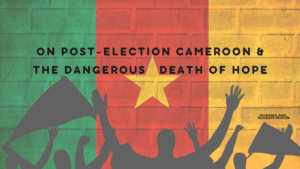
On post-elections Cameroon, and the Dangerous Death of Hope
Years ago, I began using the hashtag #MakeCameroonHopefulAgain. People thought it was a mockery of “#MakeAmericaGreatAgain”. It wasn’t. It came to mind as I thought of what we needed most. We need hope. I write this having just concluded a conversation with a friend where we discussed our sadness at another sham of an election in Cameroon and the violence already spreading. Something she said reminded me of a video I saw recently, one that explained why Gaza matters so much. Now, I know many Africans hear that and go, “Abeg, we have enough problems of our own; Congo, Sudan, Cameroon…” And they’re right. Others counter that the world isn’t even talking about those places with the same energy, and they’re right, too. Both thoughts are valid. But that video said something that struck me and has made me appreciate Africans like Zukiswa Wanner taking Gaza seriously (read about her experience HERE). There’s something about Gaza that demands attention, not because it’s more tragic than others, but because it exposes one of humanity’s most dangerous delusions. That delusion is the belief in the perfect victim. We’ve been taught, through religion, through moral philosophy, through the selective histories on Martin Luther King Jr and Mandela, that if we are peaceful enough, patient enough, and innocent enough, the world will recognise our suffering. That if we document the injustice, appeal to conscience, show the evidence, people will do better once they know better. Gaza is a brutal contradiction of that belief. We have seen everything: the bombed hospitals, the dead children, the journalists silenced, the white allies targeted, and the churches and mosques alike destroyed. It has been filmed, documented, and verified. All the UN agencies have called it a genocide. And yet, the killing continues. If “doing everything right” still ends in annihilation, what happens to people’s faith in peace, in reason, in humanity? I think back to Nigeria in 2020, and the way I felt after the Lekki Toll Gate massacre. We watched that live, too. We saw the lights go out, and the soldiers open fire on young people singing the anthem. The #EndSARS protests may have been violent in many places, but in Lekki, where most are middle- to upper-class, there was a DJ playing music. That’s as peaceful as an African protest can get. It seems like a very resolute party with young people singing, and mostly on their phones. They still got shot by the army, the same army they fund through their taxes. And years later, one of the men responsible is now the president of Nigeria. What message does that send? It didn’t matter that we knew; it didn’t matter that journalists printed evidence of his other crimes. It says: evidence doesn’t matter. Some people can get away with it. Just as their guilt doesn’t hang them, so too, your innocence doesn’t save you. Do you see the issue? The danger? Now, let’s think of Cameroon. If we think critically, we have already seen this thing play out in Cameroon, with a horrific end. The ongoing Anglophone crisis didn’t start with what we now call “Amba”. Before that, there were teachers and lawyers, peaceful, moderate people asking to be heard and for legal systems to be respected and issues addressed. And they were mocked, arrested, and belittled. When you crush the moderates, when you show that peaceful protest and following due process means nothing, you create a power vacuum. And in that vacuum, beasts rise. That is how we now have the scourge of Amba and a people turned on themselves. People keep saying the Anglophone crisis became violent because guns got into the wrong people’s hands or drugs spread among the youth. But no, before the guns and the drugs, hope left their hearts. When people no longer believe that the peaceful path works, when they no longer trust that justice or accountability exist, what else do you expect them to become? You kill the last bit of hope people have in dialogue when you turn dialogue into a bureaucratic charade (see the 2019 “national dialogue”) and use peace marches for your selfish ends. And once hope dies, people devolve. They stop caring. And here we are, seeing the same thing happen again: people’s cries are being ignored in other regions, and the evidence the masses put together is being ignored. We have seen videos of electoral fraud with no accountability. If we keep letting that happen, if we keep mocking peaceful efforts, silencing reason, and ignoring evidence, then we are the ones feeding the beast. As someone who witnessed the crisis go haywire and spoke up against it from the start, this is a perilous spiral. You cannot control the beast; it turns on anyone and everyone. I’m writing this as a follow-up to a video I shared earlier to make a note, because I am noticing a pattern. People are losing faith in processes, in justice, in peace. And when hope goes, violence rises. In fact, violence has risen, and we must acknowledge that it is not because certain people are just violent, but rather it is evidence of increasing despair. Despair is the beginning of chaos. So please, let’s not joke with the widespread expressions of despair. Protect hope.It’s not sentimental, it’s imperative for survival. Before guns get into more hands, let’s make sure hope hasn’t left their hearts.
Earlier This Year, I Was Asked About Cameroon’s Politics. Here’s What I Said…
In January of this year, I was invited by Line Sidonie Talla Mafotsing to share my reflections on Cameroon’s political culture, our history of leadership, and what lies ahead as the country prepares for elections. Unfortunately, it appears that she can no longer publish the piece for which I was interviewed. Nonetheless, I remembered the conversation and how I spoke candidly about what we have normalised as a nation, the muted sense of agency many of us feel, and much more. I’ve decided to publish some of the transcript here on my blog because the interview gave me space to think more deeply about history, memory, silence, and the guardrails we must build if we want change to mean more than just a new face at the top. And as we head into the month where we’ll be seeing yet another (sham) of an election. These words are all I have for now.
Because I did a THING! Booklaunch Vlog! (March 2025)
Dearest Reader, So… I did a thing. After last year, I had to face the fact that I wasn’t really writing anymore, not in the way I used to. I was letting fear get in the way: fear that I wasn’t good enough, that the next thing I wrote had to be serious, had to be big— like a novel or my PhD monograph. Meanwhile, I was sitting on years of poems. Real feelings. Real moments. Just… sitting there. Then I travelled to the U.S., and blogged HERE about how that trip brought back a lot. It reminded me of all the dreams I had as a kid, before the burnout, before the pressure to be brilliant all the time. I met people living their dreams—big or small, loud or quiet—but trying to live fully. That experience made me realise I was playing small. And for what? So this year, I decided: I’m doing something for me. I’m checking one thing off my childhood dream list. I took the poetry I’ve been writing since I was 26, enlisted some incredible friends to help with the shortlisting, hired an editor, and worked with a project manager… and I made a book. I self-published a poetry collection. It’s called “O Jewa Ke Eng?” which means “what’s eating you up inside?”. The title comes from a tweet that went viral while I was doing my PhD in South Africa, and it inspired one of the poems in the book. Because that question, when asked honestly, can unlock so much. It really is about holding space for what we usually keep inside. And because I’m me, a teacher through and through, I couldn’t help making it interactive. I wanted this to be something you feel with me. So, the book invites you to colour how each poem made you feel using the emotion wheel. Then there’s a colour-by-number piece at the end that becomes your emotional summary. And yes, there are blank pages for you to talk back. Write. Doodle. Cry if you need to. This book is ours now. If you made it to the launch back in March, thank you from the bottom of my heart. The love in that room? Overwhelming. But if you couldn’t make it, I’ve got you. Below is the full video of the launch, so you can experience a bit of what we shared that day. Watch it. Feel it. Tell me what moved you. Oh, and there’s a surprise within (I’m officially a songwriter lol!) Let’s talk in the comments. P.S. You can get a copy of the book on Amazon (UK, U.S., EU) or via JollyLife Bookstore in Cameroon.
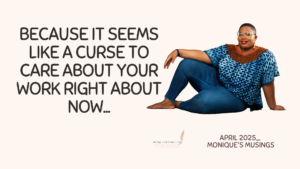
Because it seems like a curse to care about your work right about now… (April 2025)
For as long as I can remember, I’ve been drawn to people who care deeply about what they do. That’s been one of my identifiers for quality people: do you feel something for your work? Do you care enough to want it to matter? Because doing meaningful work requires you to care. Whether you’re launching a product to make life easier, teaching in a classroom, or writing research to inform policy, you have to believe that what you’re doing holds value—that it can lead to something better. And caring people value themselves and others… But lately, caring feels like a curse. Maybe it always has been, but it’s worse now. Feeling has become heavy. Only those good at compartmentalising (I truly envy you) can stay sane. Because the more conscious you are, the more you notice how little your work seems to matter. How do you keep showing up when everything feels like it’s falling apart? How do you teach justice when injustice is the norm? How do you keep researching when those in power have no intention of using that knowledge? And so my belief that work should be meaningful, which has fueled my career and life, is at this moment also what’s breaking my heart. And bringing me to the brink of a depressive episode. Why am I sharing this here? Well, LinkedIn used to be a space that showcases passion for ones [meaningful] work not just the wins as it seems now. Here we could see insights and growth. But scrolling now, I find that even the shiniest updates carry exhaustion. Beneath the achievements, there’s a quiet despair: our work is losing its meaning. As someone who works on education and social justice for development, I’m increasingly haunted by how disconnected knowledge is from action. We’ve theorized inequality to death. But even the little effort towards implementation we were making (remember all those equity and inclusion statements?) is being undone less than five years later. Because funding. Because politics. Because profit. So I ask: what’s the point of knowledge if those in power won’t use it? If it doesn’t make them money, or if they just don’t care?And this isn’t just academia. Every field, be it business, tech, health, the arts etc. is caught in a battle between purpose and performance, between meaning and metrics. I recently read a paper [my first “just because” academic read in a long while] that asked: Is scholar-activism an oxymoron? The fact that this is even up for debate made me shake my head. Shouldn’t scholarship always have been activism? Not necessarily in the marching sense, but in the pursuit of truth and justice? If not for impact, what’s the point of all this knowledge generation? Are all these citations, all these conferences for vibes?Maybe. Because clearly, we’ve drifted. We’re no longer doing meaningful work. We’re doing measured work. Ranked, rated, reduced. And that, to me, is the real crisis. There’s so much knowledge that could change lives. But who will use it? More importantly, who will be held accountable for not using it? So I’m writing this here because I’ve wondered about my own melancholy over work I chose and genuinely love. But it’s clearer now: as the work loses meaning, so does our vim. And that’s why I’m tired. Deeply, soulfully tired. It’s not normal to witness crisis after crisis and be expected to show up as usual. It’s not normal, and that’s why we’re exhausted. Constantly. I know saying this might not be the most “LinkedIn” thing to do; not here where we’re all high-achieving and always inspired LOL! But we owe ourselves honesty. I’m tired of talking about change and seeing nothing change. What keeps me going is the faint hope that maybe- just maybe- what we do now will matter later. That someone, someday, might stumble upon our work and use it to shift something. Like how that Lizzo song started to trend years after it came out, finally making her famous, maybe the paper we write today might not go anywhere till someone who cares comes to power and uses it for policy tomorrow. That hope… and, of course, the need for a paycheck, is why I keep showing up. If you’re feeling the same- disillusioned, angry, heartbroken… know you’re not alone. I believe there’s quiet a number of us of us out here. We’re trying our best to still care. Even when it doesn’t make sense. Especially then.
A Little Throwback Vlog (Feb 2025)
Back in 2019, while attending a conference in the U.S., an old acquaintance who hosted a Facebook show asked to interview me. He was curious about my feminist views and why I chose to work in Cameroon. Years later, I find myself at a similar crossroads, once again facing the familiar question: “Must you work in Cameroon?” So, I asked the brilliant videographer Glen Amungwa to turn that long-forgotten interview into a vlog. Most of the original recording had never been made public until now.Here it is. Enjoy
On one of the days, I remember I love what I do…
August 2023: Musings on What Home Means…
I’m back in Cameroon again. If you know me, you know I move around a lot. It’s both something I appreciate and something I wish I didn’t have to do. Moving around a lot means I’ve been fortunate with regards to exposure, it means I have had multiple opportunities, considering the cost of moving around and the restrictions on Africans when it comes to travel, I also appreciate that it means certain degrees of privilege. But it also means I have struggled with belonging for most of my life. It also means that I often wonder what to list as my ‘address’ when filling out a form. It also means that I struggle with settling into a routine (and I direly need a routine). It means I’m often lonely, living through my phone because that is where all my favourite people are. Finally, it means I am constantly struggling to feel at home. One of the most recurrent comments/questions I get when I am back home is “why you cam back eh? You really like this country!”. Recently I have been thinking about that. Do I like Cameroon? I don’t know. I know I love Cameroon- yes you can love something/someone without liking them; the former means you get on well, and the latter means you have a stronger bond than just how they make you feel. I know I love Cameroon because I feel belonging – relatively- in Cameroon. I know I feel a responsibility for it (who exactly do we think will come save us and fix this mess of a nation?). I know that even though other countries might offer me better services – maybe even better human dignity- it is only in Cameroon that I can demand it (even when it is not given). I think Cameroon is home not because, I’m most comfortable here (material comfort) but because I’m most understood here. I don’t need to explain what “ashia” means irrespective of what side of the Mungo I am. Here I am familiar with what ails most of us, I have learned to navigate our -isms as much as they frustrate me still. Learning how to dance around new -isms and the complexity of social problems in new countries… well I feel like a boomer navigating Tiktok. In an interview I gave in 2019 I recall explaining that my education and career have been geared towards addressing problems I identified at home; how then can I feel comfortable in a place where I’d be just another drop in the ocean, not addressing the problem that weighs in my heart. It sounds dramatic, right? Perhaps life never does me enough reach side wey I go wash foot off Cameroon follow “soft life”. But till then, I call Cameroon home for all the reasons- good or bad- that make it home.
A Conversation with Nayah Ndefru
A few months back, I had a conversation with Nayah Ndefru on her Podcast “Breaking the Code” where she gathers her networking to discuss breaking the variety of toxic cycles plaguing us individually and socially for a better quality of life and fulfilment. Watch/listen to our conversation below.
In Which I Argue that the Cameroonian Government is the Greatest Missionary of All Time…
If you were asked who the greatest missionary in all of history is, who would you name? Who would you say has called most people to Christ? Who has done so much soul-saving that you think they deserve the star on the missionary walk of fame? A lot of people will name biblical characters. But don’t be lazy, I mean think of people we can trace in modern times. At this point, you are probably thinking of some old white people: John Wesley? Mother Teresa? Benny Hinn? Billy Graham? Or perhaps you’re thinking of some Nigerian televangelists? Who? Well, irrespective of who you thought of I’m here to argue that you’re wrong. I don’t need to know the preacher’s name; all I know for sure is that they can’t take the title of the greatest missionary of all time. If a missionary is one who wins souls for Christ, then the greatest of all time is none other than African government officials. Yes, you read that right. Let me make my case: A missionary is one who promotes their faith, a Christian missionary is one who promotes faith in Christ; causes people to believe in Christ. I’ve thought long and hard, and I can’t give anyone other than African government officials more credit or pushing African people to Christ. Western missionaries may have brought it here, but it’s our government that has enabled its preservation over a century later. In fact, the government has three great missionary achievements to its credit. 1. ‘Suffer them to Come Unto Me’ In Matthew 19:14, Jesus said “Suffer the little children to come unto me. Bible translators have explained that the meaning for “suffer” there was “allow” and not the ‘suffer’ we know as of today. But the African government officials did not hear that one. No, what they – and the rest of us too- have heard is that “pain is the touchstone of spiritual growth”, that suffering draws us to God. And so they believe they are doing the Lord’s work by suffering the civil servants who after scrambling to secure a government job must then wait years before they get paid. How won’t you believe in God as a medical doctor in this country? You must believe when you see how low people are surviving despite the low chances of survival. You must believe, for your own sanity, that you will live long enough despite daily risks as a frontline worker to see the day you cash out your arrears – after the bribe of course. And so the government sends you to the altar. Now, I’m not on the side of those who say God intentionally gives us pain to bring us to him. Personally, I don’t like nor agree with that framing. I understand it, I definitely think he permits the pain and uses it for good. But the intentional cruelness of breaking you, bring you to your knees seems sadistic and not at all God-like (see James 1:13). So of course I am not going to relegate the Government’s “ministry” to just that of suffering. Nope, they have other strategies for promoting the faith. So moving on, let’s look at their second missionary achievement … 2. “In God we trust” One of the most memorable lessons of the New Testament is that which teaches us not to presume tomorrow is assured… Jesus uses the Parable of the Rich Fool (Luke 12:16–21) to teach it and James (4:15) warns against betting on tomorrow and suggest that we rather say “If it is the Lord’s will, we will live and do this or that.” Well, even if you’ve never read the bible, the Cameroonian government has taught you this lesson by virtue of their unreliability. We say “by God’s grace” automatically whether we’re active disciples of Christ or not; because if there is one thing we’re sure of, it is that nothing is sure. You may have money in the bank but you cannot be sure that the ATM would work, in fact, it is normal for them to have issues. You may have paid for a monthly data subscription but you are not sure to enjoy the data- and even if they skip days on end, you can do nothing but grumble. You are not sure of getting to work on time even if you left home early- some minister may be visiting and the roads will be blocked for hours with not consideration… Nothing is sure. No one teaches this better than governments like the Cameroonian and this makes them one of the greatest missionaries- whether they intend to be or not. In other countries where the system is reliable, you can plan for days ahead. In Cameroon courtesy of the government, doing meal prep for a week is an act of faith. You must be trusting in God because it cannot be in ENEO you trust… They have taught us dependency on Christ in a way Saker and Wellesley could never! 3. “In Everything Give Thanks” I in no way mean to suggest other countries are perfect… far from it. More developed countries have their own systematic failures. A Black-American probably has to pray that their justice system works as it should… Yet, the Cameroonian government has made thanksgiving a national practice in ways that can only be considered a missionary achievement. In the absence of a functioning system, even the littlest thing becomes a miracle. And so we hear resounding shouts of “thank God” when ENEO restores power. We clap in gratitude when the bus safely arrives Bamenda after a night journey – the way Africans elsewhere clap when the plane lands) because we know that our roads are hazardous and our driver may have acquired his license through corrupt means… We know it is a miracle that we’re not dying of Covid19 in crazy numbers, because there is literally no contact tracing done and the testing centers barely practice the measures they recommend. And while it is likely that