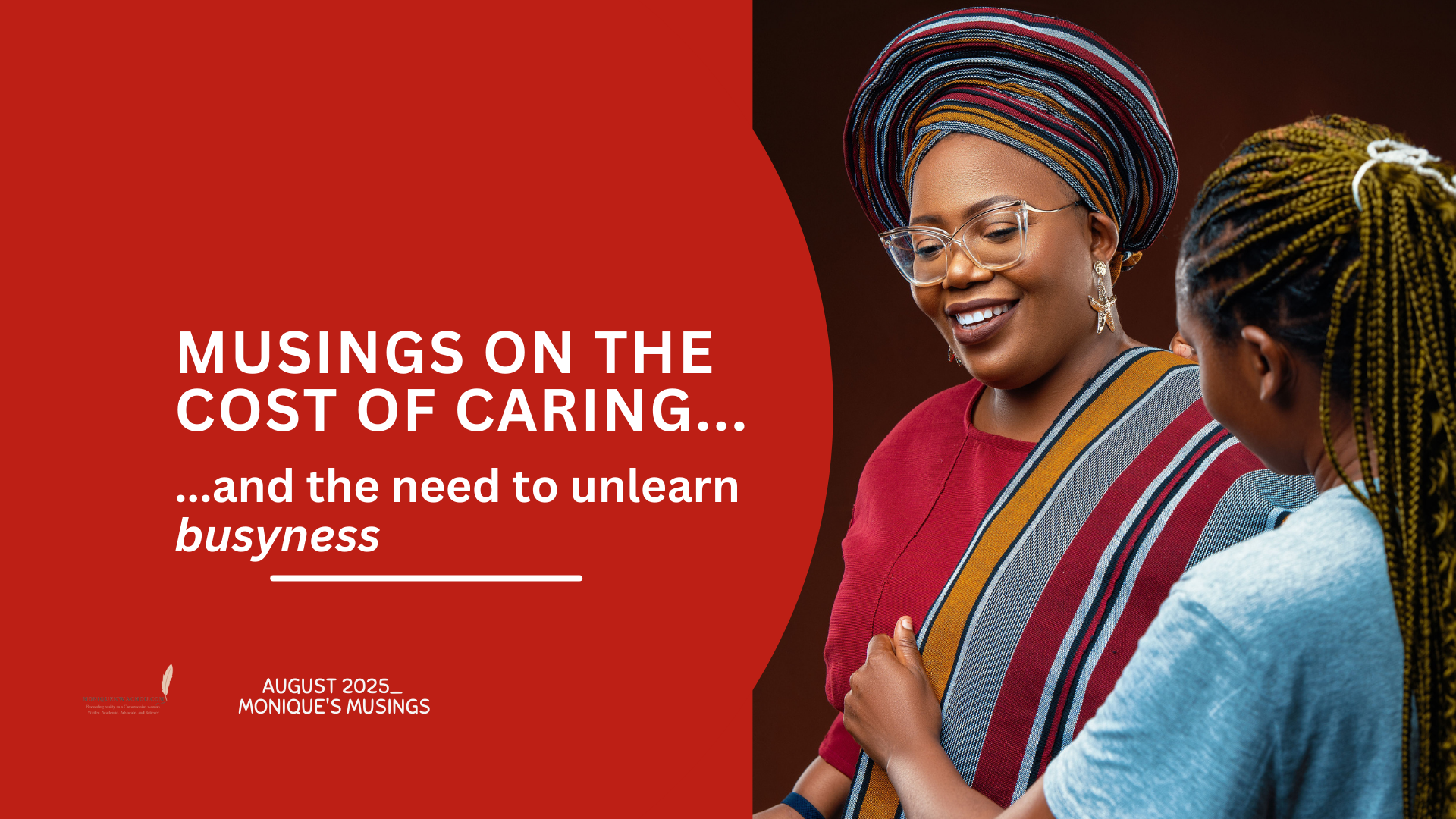
They say it costs nothing to be kind. But it does. It costs a lot. I can’t only be kind with words. I have to be kind with actions. I have to be kind with my time. I have to be kind with my energy. And all of those cost something. Attending a child’s birthday party means I need money for transport, I need money for a gift, and I need the well-being to show up and actually be present. Even just giving someone a smile requires that I myself am okay. How do I smile when I can’t afford healthcare? How do I stand up to injustice when I’m already exhausted, working three jobs just to survive? Kindness costs. Caring costs. Humanity costs. And those in power know it. They have always known it. They bank on it. They keep building on systems of inequality because nobody interrupts them. The people who might have disrupted it before us were busy trying to survive. Just like we are busy now, and because we’re busy now, they will keep accumulating, and it will get worse in the future. Today we decry the glaring inequalities with the wealthiest 1% owning almost more than half the world does, but Elon didn’t get rich today, he was given the tools generations ago. These billionaires had the systems already in place, and because nobody stopped them then, we can’t stop them now. Humanity costs. And you know what? Upon reflection, I believe the greatest evil, the most significant threat to humanity, isn’t even the billionaires or the politicians. It’s our busyness. That’s the real enemy. It’s the way capitalism has cultivated a culture of individualism, where we’re constantly occupied and constantly trying to survive. Because as much as I want to help, I can’t help when I myself need help. So people postpone caring until it’s convenient. We postpone showing up at protests because we have to clock in at work. We postpone resisting oppression because it’s hitting someone else first, not us. We stay busy until it comes knocking directly on our door. Our occupations are the biggest threat to our humanity. And they know this. They know we cannot afford to care in a capitalist system, so they keep us anxious, they keep us hustling, they keep us busy. I remember one time I was in a clando from Buea to Douala. The driver got stopped, as usual, by gendarmes looking for a bribe. They started nitpicking at his papers. He had already paid money at so many stops that day, and he got angry. He said, “How much do I even make on this route if every time I pass, I give you something?” He refused. He was furious. But the gendarmes just stood there, waiting. And one by one, passengers started getting out of the car. They didn’t want to be delayed. They didn’t want trouble. And I understood them. I was quiet at first. But then I saw the gendarmes watching, amused, knowing the driver would eventually cave in, because without passengers, he’d lose everything. And I thought to myself: this is exactly how oppression works. They bank on our time, our impatience, our busyness. That day I decided to stay. I stayed in the car. Just one other passenger and I did so. And I said to myself, I’ll try to cover the cost of one other passenger who left, I’d pay for that seat, so the driver wouldn’t lose everything. The money was a sacrifice, but the look on that man’s face… I’ve never forgotten it. I recall tweeting about it at the time. He needed our presence so that it wouldn’t look like his defiance was madness. That day taught me that resistance requires time. Resistance requires forfeiting comfort. It requires staying put when it would be easier to leave. And not everyone can afford that. It reminded me of another moment, in 2017, during the protests at the University of Buea. In a meeting, the administrators were giving the Vice Chancellor their account of what had happened. They were blaming the students, blaming ethnic groups, twisting the truth. I sat there listening, afraid. And then I opened my mouth. I said, “That is not what happened.” I corrected the story. My heart was pounding. I was so afraid that I secretly called a friend on WhatsApp and pressed record so there would be proof of what I said. Later, I told my godmother about it, and she said something I will never forget: “That was a privilege.” And she was right. I was young, single, no children, no dependents. If I lost my job, I could try finding another one. But for my colleagues with families to feed, parents depending on them, the cost of courage was too high. It wasn’t that they didn’t care. It was that they couldn’t afford to care. That is the reality of capitalism. That’s the reality of our world. Life doesn’t give us margin. You may care deeply about Palestine or Congo or Sudan, but that doesn’t mean you can sacrifice your child’s school fees for the cause. You may want to protest, but you can’t risk losing your job. You may want to speak truth to power, but you know it won’t only cost you; it’ll cost everyone who depends on you. And so, some people fight from within the system, while others choose to leave and love their country from afar. And I’ve learned not to judge either choice, because both come from the same truth: humanity costs, and not everyone can pay. But here’s the part that scares me the most. The powerful know this. They count on it. They count on our busyness, our fatigue, our survival. They count on us not having the privilege to resist. And as long as they can keep us in that state, they will continue to win. So when people say kindness costs nothing, I shake my head. No.
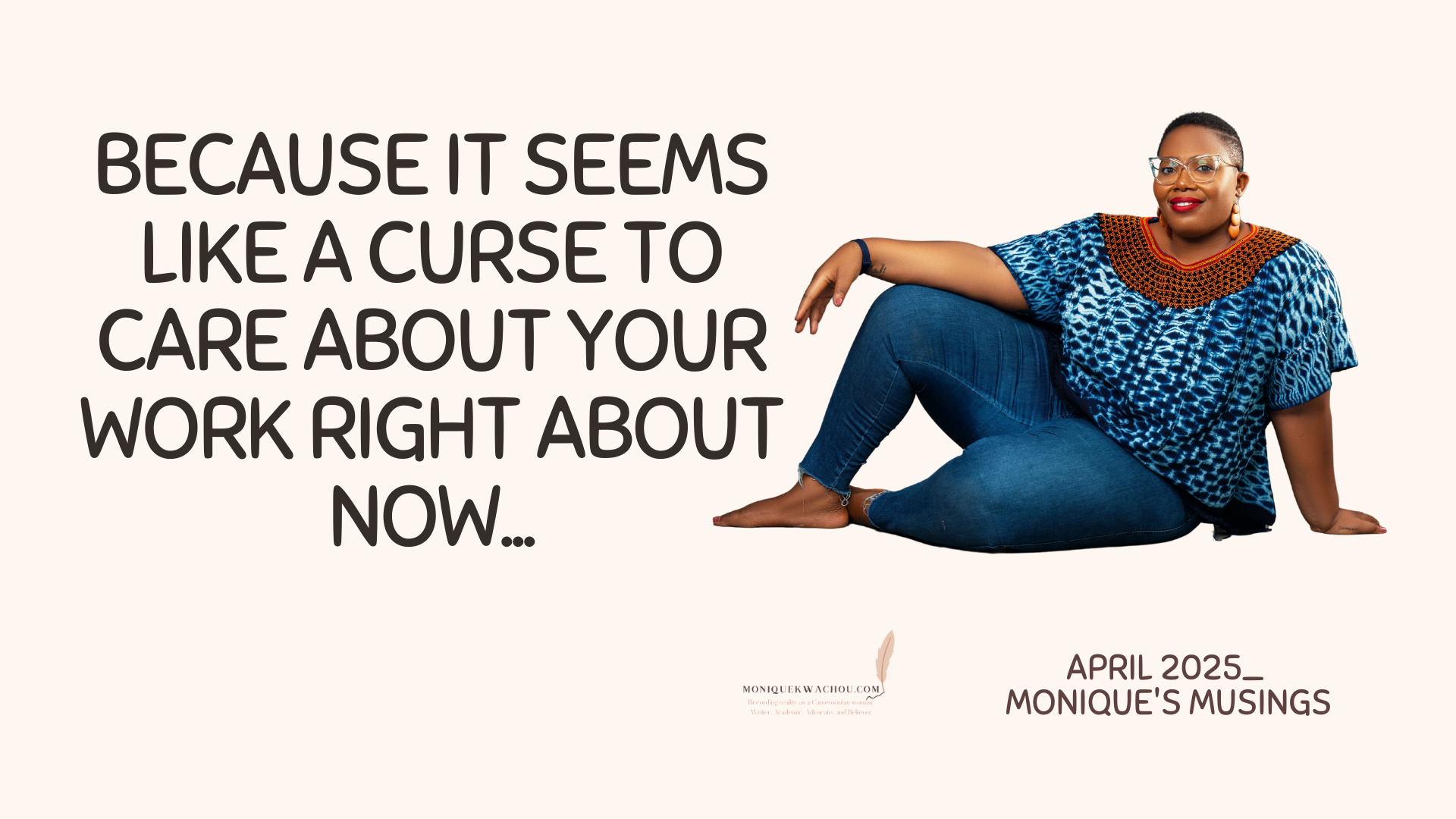
Because it seems like a curse to care about your work right about now… (April 2025)
For as long as I can remember, I’ve been drawn to people who care deeply about what they do. That’s been one of my identifiers for quality people: do you feel something for your work? Do you care enough to want it to matter? Because doing meaningful work requires you to care. Whether you’re launching a product to make life easier, teaching in a classroom, or writing research to inform policy, you have to believe that what you’re doing holds value—that it can lead to something better. And caring people value themselves and others… But lately, caring feels like a curse. Maybe it always has been, but it’s worse now. Feeling has become heavy. Only those good at compartmentalising (I truly envy you) can stay sane. Because the more conscious you are, the more you notice how little your work seems to matter. How do you keep showing up when everything feels like it’s falling apart? How do you teach justice when injustice is the norm? How do you keep researching when those in power have no intention of using that knowledge? And so my belief that work should be meaningful, which has fueled my career and life, is at this moment also what’s breaking my heart. And bringing me to the brink of a depressive episode. Why am I sharing this here? Well, LinkedIn used to be a space that showcases passion for ones [meaningful] work not just the wins as it seems now. Here we could see insights and growth. But scrolling now, I find that even the shiniest updates carry exhaustion. Beneath the achievements, there’s a quiet despair: our work is losing its meaning. As someone who works on education and social justice for development, I’m increasingly haunted by how disconnected knowledge is from action. We’ve theorized inequality to death. But even the little effort towards implementation we were making (remember all those equity and inclusion statements?) is being undone less than five years later. Because funding. Because politics. Because profit. So I ask: what’s the point of knowledge if those in power won’t use it? If it doesn’t make them money, or if they just don’t care?And this isn’t just academia. Every field, be it business, tech, health, the arts etc. is caught in a battle between purpose and performance, between meaning and metrics. I recently read a paper [my first “just because” academic read in a long while] that asked: Is scholar-activism an oxymoron? The fact that this is even up for debate made me shake my head. Shouldn’t scholarship always have been activism? Not necessarily in the marching sense, but in the pursuit of truth and justice? If not for impact, what’s the point of all this knowledge generation? Are all these citations, all these conferences for vibes?Maybe. Because clearly, we’ve drifted. We’re no longer doing meaningful work. We’re doing measured work. Ranked, rated, reduced. And that, to me, is the real crisis. There’s so much knowledge that could change lives. But who will use it? More importantly, who will be held accountable for not using it? So I’m writing this here because I’ve wondered about my own melancholy over work I chose and genuinely love. But it’s clearer now: as the work loses meaning, so does our vim. And that’s why I’m tired. Deeply, soulfully tired. It’s not normal to witness crisis after crisis and be expected to show up as usual. It’s not normal, and that’s why we’re exhausted. Constantly. I know saying this might not be the most “LinkedIn” thing to do; not here where we’re all high-achieving and always inspired LOL! But we owe ourselves honesty. I’m tired of talking about change and seeing nothing change. What keeps me going is the faint hope that maybe- just maybe- what we do now will matter later. That someone, someday, might stumble upon our work and use it to shift something. Like how that Lizzo song started to trend years after it came out, finally making her famous, maybe the paper we write today might not go anywhere till someone who cares comes to power and uses it for policy tomorrow. That hope… and, of course, the need for a paycheck, is why I keep showing up. If you’re feeling the same- disillusioned, angry, heartbroken… know you’re not alone. I believe there’s quiet a number of us of us out here. We’re trying our best to still care. Even when it doesn’t make sense. Especially then.
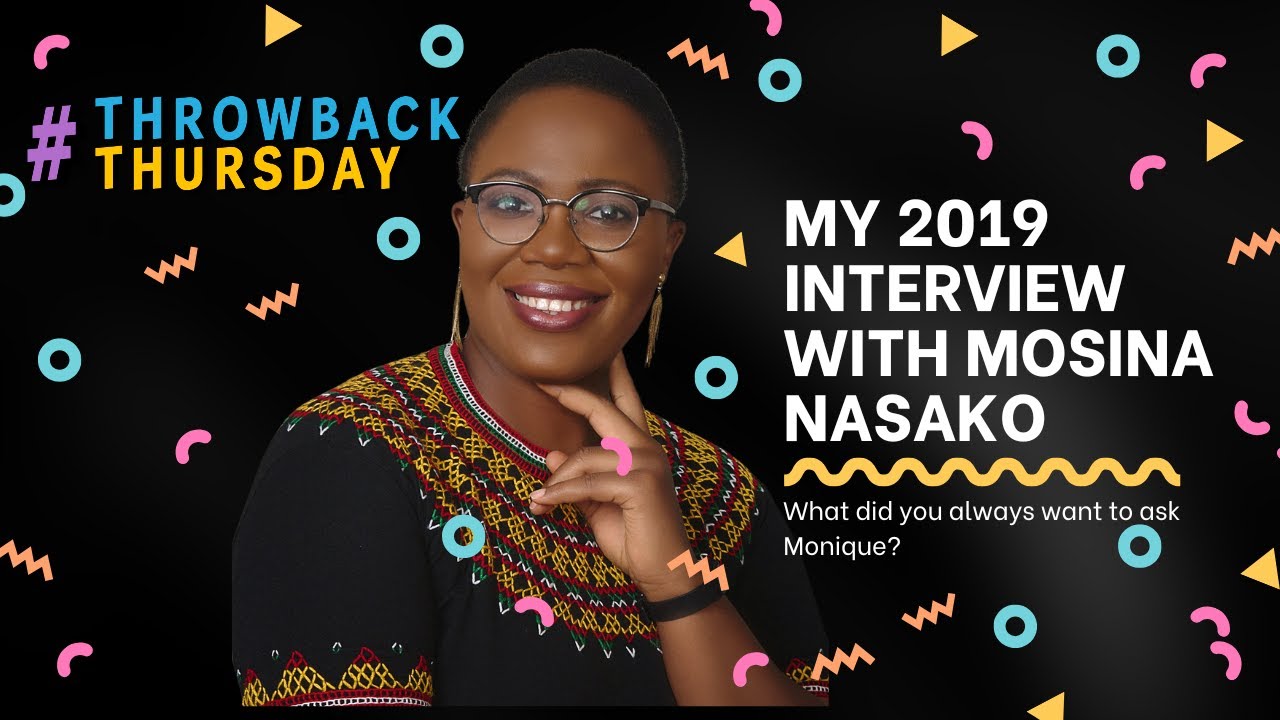
A Little Throwback Vlog (Feb 2025)
Back in 2019, while attending a conference in the U.S., an old acquaintance who hosted a Facebook show asked to interview me. He was curious about my feminist views and why I chose to work in Cameroon. Years later, I find myself at a similar crossroads, once again facing the familiar question: “Must you work in Cameroon?” So, I asked the brilliant videographer Glen Amungwa to turn that long-forgotten interview into a vlog. Most of the original recording had never been made public until now.Here it is. Enjoy
On one of the days, I remember I love what I do…
2024 My Year Of No? (Dec 2023 Blog)
It has become a tradition of mine to have a theme for the year; a word or phrase that speaks of my intention for the new chapter. It is not a resolution but a word that captures what I hope will be an undercurrent of my actions throughout the year. Still, I think this past year was my first ‘successful’ realization of a ‘thematic year’. Not because I ‘achieved a lot’ but because it was the most intentional I have been with a theme. See when I declared 2023 my Year of Self-Love, I outlined how I would take steps to finally love the body I’m in, to truly love myself. E.g. 1- Loving myself by doing things the self loves e.g taking swimming lessons. 2- Loving self by investing in mental health treatments more than ever. 3- Loving self by giving away all the clothes that no longer fit and getting new clothes that do. 4- Loving self by gifting myself the way I gift others, by asking for help and delegating what t I cannot do. 5- Loving self by getting to know the one who made me – God – and drawing myself worth from Him etc. The above are just a few ways I intentionally sought to live out the theme I declared, and to an extent, the year of self-love worked. I became better at the swimming I loved doing- even swan in the deep end for the first time, I entered a New Covenant with Yahweh last year, I bought myself a brand new phone for the first time last year, I even dared to remove the enlargement of my Boudoir shoot photo it’s in my bedroom but at least no longer hidden… Yet some things remain the same. At the junctures of my year of self-love, I hated myself as ever before or more than ever before. As much as I was proud of loving myself enough to openly ask for help, I still hated that I needed to keep asking for help. Another way my thematic practice was different this past year lies in the fact that this was the first year that I assessed the theme. I intentionally looked back at what I had been doing towards that theme and whether I could see changes or not. And perhaps because I did that reflection, I could appreciate that working on self-love as someone who struggles with that area cannot be limited to a year or any timeframe for that matter. The greatest success of the year of self-love therefore was coming to accept that this struggle might be never-ending; it took 30 years to internalize the reasons and ways I dishonor myself, and it won’t be healed in a year, no matter how much I do differently. It is also as a result of the above reflection that I can go into making a theme for this year more intentionally than ever. As we usher in a New Year and I declare a new theme for 2024, I am aware that the old theme has not been “done and dusted”. My declaration of this year as “my Year of No” is, in fact, an extension of last year’s theme of Year of Self-love. How so? This year, with this theme, I am declaring an intention to love myself better and more by doing less so I can heal. One thing that has come through clearly in the past years has been how burn-out, depression and years of pent-up issues all came ahead to break me between 2020 and 2022. However, I kept thinking I could just push through it, and try harder. So I have shamed myself for not being as I was before; as committed to goals, as disciplined, as attractive as talented etc. But shaming does nothing but fuel the depressive episodes. I think what finally got me to think differently was trying on the idea of a Year of No; when I first considered it everything in my being protested. Do I deserve a year of NO when the last 2-3 years have been my most unproductive? Shouldn’t I be trying to achieve goals, and check off to-do list items that have been languishing on my Google Keep for ages? But then I saw this quote: “You’ve been beating up yourself for years and it hasn’t worked, try giving yourself grace and see what happens”. As I have nothing to lose at this point, I think I’ll try the reverse psychology. I’m permitting myself to fail at doing and being it all. In fact, you can’t fail at what you were never meant to do: so this year I want to try having as little to nothing on the to-do list to shame myself for ‘failing’ at. I give myself permission to do nothing but hibernate. I want to rediscover reading for fun. What does a Year of No entail you might wonder? Well, in 2017, when I declared my Year of Yes, I said yes to every opportunity that came my way. I said yes to trying over and over again. I stopped limiting myself to what I wanted (e.g a distance learning PhD) and said yes to whatever I was offered. That was the season for that. This season is different and I must acknowledge that even if I don’t like it. So in this season, I’ll say more no’s or respond with not now, maybe later. I will avoid taking up any additional tasks; no more signing up for things and then asking God for the strength to do them. No more asking for more strength when the body has made it clear it wants to rest. This article gives a great idea of what declaring A Year of No may entail for others… This might sound counterintuitive. And I admit it reeks of privilege. Yet, I am willing to live out this privilege with gratitude. I have found I must question the desire
Sept 2023: Healing My Writing Soul
A recently unlocked memory is of the day my O’ Level GCE results were read. The year was 2006, I had convinced my mom to let me go visit a friend who lived in Baffoussam. It was my first real trip away from home initiated by me. It helped that the said friend was our Senior prefect in school and hence they assumed she was a responsible friend LOL! Anyway, when my results were made known to my family, a plethora of congratulatory calls came in. In the course of one such call, my aunty asked me the age-old question “So what do you want to be when you grow up?” Monique opened her mouth and said ” I want to be a writer” LOL! Did I know what I was saying? I didn’t (ugh! I miss that hopeful naive me), I did however know that books were saving my sanity at that time. Books were giving me solace and places to escape and teaching me better about the world and other humans than my teachers… and so I wanted to be a writer, to create that escape for someone else. I have written about the development of myself as a writer elsewhere (see here) but that was before experiencing the Anglophone Crisis that helped me narrow down my writing voice and writing soul so-to-speak. That was also way before multiple experiences made my writing voice, soul and dreams shrivel up to near death. Like most things, gifts don’t die suddenly nor all at once; they weather away. In 2020, I wrote a poem about no longer being able to write- it sounds ironical I know- but it was me perceiving and reporting the weathering. The loss that was already happening. I wrote the above poems 3+ years into the Anglophone Crisis and 2+ years into a horrible ‘situationship’. Both experiences made me lose my faith in the power of words, my writing and writing in general. So many of my articles were on the Crisis and those who read them were not those who needed to, those who needed to read and be moved do not read. Similarly, so many of my poems were love poems for someone who read them but would still not be moved/understand enough to reciprocate, to love me back. So I stopped writing. After all, I thought, what good was bleeding in words when the people just watched you bleed like it was a sport you enjoyed playing? And was I even writing ‘right’ if it didn’t move people to action if it didn’t reach the right ears/eyes, win the heart I yearned for? No, I thought. And so I stopped. Several years later, I recognize that reaction as a trauma response and regret giving up my gift. Stopping had its consequences. That kind of thinking- that other people’s actions or inaction depended on how well I wrote or did not write- fed my already bad case of perfectionism. And so here I am with a book deal unable to write. Struggling to believe in the power of words again. Forcing myself to write blog posts even if they’re months late. I’m praying for the gift to return, hoping its like riding a bicycle or swimming- a skill your body remembers. This time, when I say “I want to be a writer”, I know what I’m talking about. I have a better ‘why’, so I pray the gift returns.
A Conversation with Nayah Ndefru
A few months back, I had a conversation with Nayah Ndefru on her Podcast “Breaking the Code” where she gathers her networking to discuss breaking the variety of toxic cycles plaguing us individually and socially for a better quality of life and fulfilment. Watch/listen to our conversation below.
Lessons on Leadership…
In January 2013 I filed the application for the establishment of Better Breed Cameroon. I was a young woman with big dreams and a lot of hope, I miss that version of me for all the hope and zeal she had. Ten years later we’re celebrating a decade of youth development work and contribution to nation-building through Better Breed Cameroon. Our current community manager- Mrs. Ayuk Renette asked me to share lessons on leadership or what I would pass on to aspiring leaders. I made these very brief points because I know she was looking for social media content 🙂 I look forward to learning many more lessons in future. What leadership lessons have you learned? Let me know in the comments!
So why/how do you use LinkedIn?
I was having a mentoring session with a 22-year-old over a week ago and asked her if she has a LinkedIn profile.She said she had just registered on the platform but that there was barely anything on her profile and that “she doesn’t know how to use it”. Recognizing a flimsy excuse I quickly asked her how she learned to use other social media… she says, well with others you already have your “friends” on board to interact with. With LinkedIn, she got recommended connections based on her geopolitical location and the persons’ popularity, so she was recommended to follow our most popular Cameroonians in the corporate world (Rebecca Enonchong and co.) While the part about who/how LinkedIn recommends surprised me, her inability to see value in this platform did not. Through my youth work with Better Breed Cameroon I’ve discovered young Cameroonians don’t value this platform as much as you’d think people actively seeking work would. For them, (and many others) LinkedIn is for people who’ve already made it. They come on here and see as she said in her own words “people always posting an achievement at work or a new job”…This platform is undoubtedly daunting for someone like her; a recent graduate who has had very limited educational and career counselling. She’s someone with a broad-based B.A in Journalism and Mass communications but no idea if and how to use it (and considering changing her field completely to procurement) because the concern for her (as is the case with most graduates) is what can I do to get money immediately! Young people (like her) whom I have worked with feel (and this is a whole other topic to be discussed) that they should be able to monetize the qualification they just completed. So if signing up on Linkedin with their fresh degree won’t “get them a job”, why sign up, they ask? But using LinkedIn as an employment tool is playing a long game. People don’t share this enough. I recall my disbelief when a writer friend (who was also a doctoral scholar of law at the time) mentioned being scouted on here. I didn’t think it happened to people like us- Africans working on the continent. At the time I was on LinkedIn not in hope of getting recruited, but rather in hope of networking with people I could only aspire to be like. I stalked their profiles as I envisaged and planned mine. You could say LinkedIn served as my vision board at the beginning… Then, being a writer I thought to chronicle my career journey here with LinkedIn articles, to share my work and build a profile… second reason for use- is branding. Soon as a graduate student I’d see it as useful for finding funding opportunities, soliciting the necessary recommendations, following up on the development agencies I was interested in for research… And finally, LinkedIn was the social media platform I could share news of this conference or that fellowship with people who get it/would appreciate it just as much- unlike FB for instance where family and friends would just ooh and ahh not over what I was wearing in the photo (nothing bad about that of course). So a place for meeting like minds? I thought of all these reasons when the mentee I mentioned earlier asked me: “is LinkedIn useful for you? Is it helping you get work?” If I told her yes, I’d be insinuating that I’ve landed one of my previous or current jobs solely via LinkedIn and that is a lie. But I also couldn’t say ‘no’ because I’ve within the past year – over a decade on this platform- I’ve been solicited by recruiters for potential consulting work thrice. So obviously the potential is there… but the profile they’re looking for took 11 years to build. So what did I tell her? I said simply “that it has its uses”. I want her to see LinkedIn for all the uses I’ve outlined above and more, I want young people like her to see beyond the endless posts of people “humble bragging” about achievements… To see that people like her can use it as a vision board, use it to network and reach out to people whose contacts they’d never get otherwise… use it to find a fellow Cameroonian at a foreign university you’re moving to or a fellow black woman in a predominantly white space. Use it to amplify your work and the works of your friends (p.s check out this amazing paper by my MILEAD sis @RamaDieng). Use it as Twitter for the corporate world and call out institutions if you have to. Use it to dream out loud by posting your career aspirations and motivations (the right person just might come along to support you…). Use it to do background checks on potential employers (and employees). Use it to keep abreast of what is happening in your field etc. In all these different uses lie personal branding, credibility building, knowledge acquisition and more which leads to the employment one desire… that’s the long game! But you can enjoy the now too! E.g the featured image is me laughing out loud in delightful conversation with a friend I first made acquaintance with on LinkedIn 😊 I’m sending this to piece to the person who inspired the writing of it and other mentees as my very long response to that question upon reflection and thought to share it here too. This is not a paid promotion for LinkedIn lol! But enough about me, what about you? Why/how do you use LinkedIn P.P.S I’d love to be an assessor for perhaps an undergraduate- research project looking at how many Cameroonian employers look up their potential employees’ LinkedIn accounts (or other social media) prior to employment… someone should pick up this research idea!
Want to have a successful year? How are you defining success?
What if I told you, there’s a way to guarantee you have a successful 2022? Well, I can; because a successful year all depends on how you define success. Here’s a definition I recommend.