Skip to content

Monique Kwachou

Welcome to my digital corner of the web. This is a space for thinking, writing, remembering, and speaking in public. Whether you are here to read, research, or collaborate, the door is open.

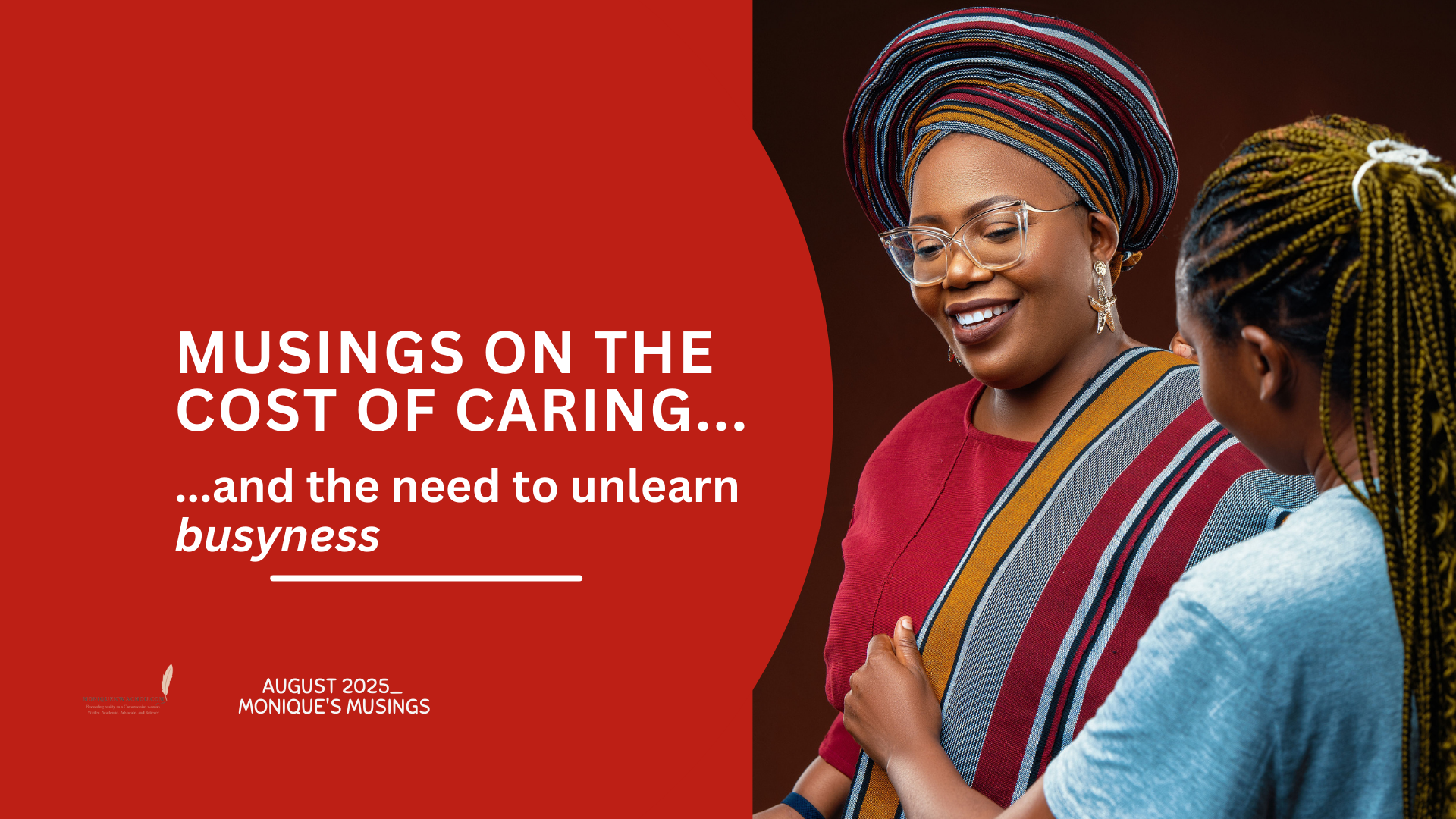
Musings on the Cost of Caring… and the need to unlearn busyness (Aug 2025)

Career Journey Reflections,  Feminist Rants,  Life Lessons & Rambling,  Socio-political Commentary on Cameroon

They say it costs nothing to be kind. But it does. It costs a lot. I can’t only be kind with words. I have to be kind with actions. I have to be kind with my time. I have to be kind with my energy. And all of those cost something. Attending a child’s birthday party means I need money for transport, I need money for a gift, and I need the well-being to show up and actually be present. Even just giving someone a smile requires that I myself am okay. How do I smile when I can’t afford healthcare? How do I stand up to injustice when I’m already exhausted, working three jobs just to survive? Kindness costs. Caring costs. Humanity costs. And those in power know it. They have always known it. They bank on it. They keep building on systems of inequality because nobody interrupts them. The people who might have disrupted it before us were busy trying to survive. Just like we are busy now, and because we’re busy now, they will keep accumulating, and it will get worse in the future. Today we decry the glaring inequalities with the wealthiest 1% owning almost more than half the world does, but Elon didn’t get rich today, he was given the tools generations ago. These billionaires had the systems already in place, and because nobody stopped them then, we can’t stop them now. Humanity costs. And you know what? Upon reflection, I believe the greatest evil, the most significant threat to humanity, isn’t even the billionaires or the politicians. It’s our busyness. That’s the real enemy. It’s the way capitalism has cultivated a culture of individualism, where we’re constantly occupied and constantly trying to survive. Because as much as I want to help, I can’t help when I myself need help. So people postpone caring until it’s convenient. We postpone showing up at protests because we have to clock in at work. We postpone resisting oppression because it’s hitting someone else first, not us. We stay busy until it comes knocking directly on our door. Our occupations are the biggest threat to our humanity. And they know this. They know we cannot afford to care in a capitalist system, so they keep us anxious, they keep us hustling, they keep us busy. I remember one time I was in a clando from Buea to Douala. The driver got stopped, as usual, by gendarmes looking for a bribe. They started nitpicking at his papers. He had already paid money at so many stops that day, and he got angry. He said, “How much do I even make on this route if every time I pass, I give you something?” He refused. He was furious. But the gendarmes just stood there, waiting. And one by one, passengers started getting out of the car. They didn’t want to be delayed. They didn’t want trouble. And I understood them. I was quiet at first. But then I saw the gendarmes watching, amused, knowing the driver would eventually cave in, because without passengers, he’d lose everything. And I thought to myself: this is exactly how oppression works. They bank on our time, our impatience, our busyness. That day I decided to stay. I stayed in the car. Just one other passenger and I did so. And I said to myself, I’ll try to cover the cost of one other passenger who left, I’d pay for that seat, so the driver wouldn’t lose everything. The money was a sacrifice, but the look on that man’s face… I’ve never forgotten it. I recall tweeting about it at the time. He needed our presence so that it wouldn’t look like his defiance was madness. That day taught me that resistance requires time. Resistance requires forfeiting comfort. It requires staying put when it would be easier to leave. And not everyone can afford that. It reminded me of another moment, in 2017, during the protests at the University of Buea. In a meeting, the administrators were giving the Vice Chancellor their account of what had happened. They were blaming the students, blaming ethnic groups, twisting the truth. I sat there listening, afraid. And then I opened my mouth. I said, “That is not what happened.” I corrected the story. My heart was pounding. I was so afraid that I secretly called a friend on WhatsApp and pressed record so there would be proof of what I said. Later, I told my godmother about it, and she said something I will never forget: “That was a privilege.” And she was right. I was young, single, no children, no dependents. If I lost my job, I could try finding another one. But for my colleagues with families to feed, parents depending on them, the cost of courage was too high. It wasn’t that they didn’t care. It was that they couldn’t afford to care. That is the reality of capitalism. That’s the reality of our world. Life doesn’t give us margin. You may care deeply about Palestine or Congo or Sudan, but that doesn’t mean you can sacrifice your child’s school fees for the cause. You may want to protest, but you can’t risk losing your job. You may want to speak truth to power, but you know it won’t only cost you; it’ll cost everyone who depends on you. And so, some people fight from within the system, while others choose to leave and love their country from afar. And I’ve learned not to judge either choice, because both come from the same truth: humanity costs, and not everyone can pay. But here’s the part that scares me the most. The powerful know this. They count on it. They count on our busyness, our fatigue, our survival. They count on us not having the privilege to resist. And as long as they can keep us in that state, they will continue to win. So when people say kindness costs nothing, I shake my head. No.

August 31, 2025 / 0 Comments
read more

Five Things That are Marketed as Feminist but are NOT!

Feminist Rants

These days feminism is a buzzword. On one hand, nearly everyone has some dastardly opinions on feminists even if they can’t clearly define what feminism is. On the other hand, every other product, event or even phrasing is marketed as if it were “women empowering” or “feminist”. For those who know what feminism is, the whole thing is pretty annoying. I’ve written about the former problem- the misconceptions around what feminism is- and that is why I’m no longer correcting people when they say nonsense like “I’m not for feminist, I’m more of an equalist”. But I have never before addressed the latter problem; the over-marketing of the wrong things as “feminist” and the way that ruins the work of the movement. So today I want to focus on that. I’ll be presenting some five common phrases/notions/happenings that are marketed as feminist but are NOT. 1. GirlDad You’ve probably seen #GirlDad here or there under some new dad’s post. The hashtag has been pushed as an impactful statement; the men using it are articulating their pride in being a father to a daughter in a world where daughters have not been valued as much as sons are. #GirlDad has also been used to articulate the belief that being a father to a daughter is a different experience; you often hear men saying “having a daughter helped me appreciate/respect women”. In so doing men reveal how they become more sensitive to the inequalities and dangers faced by the female gender when they have a daughter. So what is wrong with this supposedly impactful statement, and why is it a clear example of something which has been wrongly branded as feminist? Simple answer: it is being used in the wrong way. While the initial motive of the hashtag #GirldDad (promoting pride in having daughters) is laudable, the hashtag has unfortunately been used to reinforce stereotypes that some things are “girl things” and others are “boy things” (same problem with the #BoyMom hashtag) and this is anything but feminist. Being a girl dad on social media has been presented as being a father who is overprotective “because he has daughters to guard” (interestingly from members of his own gender), a father who does stereotypically girly things, and a father who is suddenly more sensitive to the inequalities and dangers faced by the female gender because he has a daughter. There is a fine line between emphasizing the equal value of daughters and making one gender more ‘special’ than the other and the #GirlDad hashtag often crosses it.  Also, one should not need to have a daughter to recognize the equal value of girls and women to boys and men, so parading that is anything but feminist. Perhaps the most annoying thing about the hashtag is how capitalism has used it to now market stereotypically “girly” things to men “don’t you want to be a girl dad, buy this unicorn hat and prove it”. 2. “Split the costs 50/50, match his game” Contrary to popular belief, splitting the bill 50/50 is NOT FEMINIST. Hear me out, I know some anti-feminists will be vexed by this one. Feminism is used to refer to the belief (and the movement which acts on that belief) that men and women should have equal rights, opportunities, responsibilities and fair treatment. Read that again and see the word SHOULD. This- gender equality- is what we believe and advocate SHOULD be. Gender equality is the desired state where the “rights, responsibilities and opportunities of individuals will not depend on whether they are born male or female” (Warth and Koparanova, 2012). That is the desired state, the state we’re advocating for; it is the goal but it is not the current reality, NOT YET. We are still in a state of prevalent gender inequalities. Now, Gender equity refers to the efforts being made to reverse gender inequalities and ensure fairness between men and women so that the desired state of gender equality will one day be realized. We practice gender equity because we recognize that social norms and power structures have historically (and continue to) impact the lives and opportunities available to men and women differently and ensure imbalance and inequalities. We practice gender equity by enforcing measures to compensate for the historical disadvantages one gender has faced (and continues to face) to create a more levelled playing field. In sum, equity leads to equality. Without equity, there cannot be equality. Hence, until things are equitable, until the situation where men and women both have equal rights, access to work, same pay, same responsibilities as parents, same expectations of them in our society etc. we can’t be doing anything 50/50/ UNTIL THEN, there can be NO EQUALITY. To ask someone who is earning less, and being demanded more to split 50/50 is NOT FEMINIST. What that means, is you are asking them to act as if they were in the desired state when they are not. This issue is regularly used to gaslight feminists with statements like “don’t you people want equality?” Unfortunately, there are too many who trip on their tongues when faced with this question because their understanding of feminism and feminist thought is shallow. The feminist goal is fairness; so if women expect to receive more financial support from men in a society that historically and continuously favours men with higher pay, better work opportunities, and less domestic responsibility, then that expectation is not unfair, it is their way of being “compensated” for the “traditional” role they are forced to play (and that compensation is not enough, to be honest). This ‘compensation’ may look like bias against men/for women to those who are less aware of their privilege. To that, I say: educate yourself. 3. “A Beauty with brains” First of all, I forgive myself for once believing this was a compliment and smiling at being described as such. Most who use the “beauty with brains” phrase as a compliment have something alike to those who used #girldad;

March 28, 2022 / 7 Comments
read more

Dear Fellow Cameroonians, Do us a Favor and Educate Yourself this Women’s Month!

Feminist Rants

As someone who is very vocal about being a feminist and someone who teaches feminist studies, I would get tagged on Facebook posts meant to ‘trigger’ my reaction on a DAILY basis. Thankfully, I unfollowed the worst offenders and used the security options to limit who can tag me on posts.  Still, I am acquainted with people who send me things directly either to make their argument “see what is wrong with that you people’s feminism?” Or to genuinely ask “what do you think about this?” The latter are few and far between.    A while ago, I came across a post by writer Chika Unigwe which struck me. I cannot find the exact tweet, so to paraphrase her:  “I do not owe anyone knowledge on social media. Unless you are a student in my classroom, it is not my responsibility to educate you”.  The statement might seem outright arrogant and elitist. After all, those who don’t share knowledge are just being selfish right? Nope, that’s not right at all. The statement is not grounded in the refusal to share knowledge, but rather in the refusal of the obligation too often forced on those who are conscious, those who are marginalized and oppressed to do the FREE and emotionally-draining work of educating those who partake in oppressing them. Audre Lorde puts it best in her collection entitled Sister Outsider: Essays and Speeches: Black and Third World people are expected to educate white people as to our humanity. Women are expected to educate men. Lesbians and gay men are expected to educate the heterosexual world. The oppressors maintain their position and evade their responsibility for their own actions. There is a constant drain of energy which might be better used in redefining ourselves and devising realistic scenarios for altering the present and constructing the future. Too often, those who request explanations from believers and advocates of a certain cause- whether that is believing in Christianity of advocating for feminism or protesting Anglophone marginalization- do so from the position of “I already know I’m right, but I want to have fun” or “my knowledge is superior, I dare you to prove me wrong”. As such, explaining anything becomes a sort of thesis defense.    Imagine it: having to regularly defend that you are just as human and deserving of equal opportunities, equal rights, and just treatment. That is what feminists have to do online nearly every damn day. And this is because most people don’t know what feminism is. They don’t want to. We all have the ability and resources to educate ourselves, and if one’s curiosity is genuine they would put in the work, and look for reliable sources rather than jump the wagon and preach based on social media posts often taken out of contexts. And that is just it, a lot of the curiosity is not genuine so they don’t put in the work. They ‘just share’ what suits their own pre-conceptions. So why- unless you’re paid for it- would anyone want to engage in educating them?    God knows I’m tired of it and after this blog post- where I’ll be sharing my perspective and details on an ongoing campaign that can serve as a resource for the genuinely curious-  I’m resigning from it.    Last year, I was interviewed by Toridey on a variety of issues, feminism among them. Please see the video below:    This year, my organization Better Breed Cameroon is running a #WomensMonth2020 campaign on all our social media to shed light on women whose contribution to nation-building has been undervalued,  women whose sacrifices and abuse has been given inadequate attention and the general status of gender issues in Cameroon that speaks to just why we need feminism.    See below release for details:  From now henceforth, this post will serve as my response to any requests for free explanations. I hope you enjoyed it and I hope those who need to educate themselves!   As always, your comments are welcome! 

March 1, 2020 / 1 Comment
read more

Attending the 2016 African Feminist Initiative Conference

Career Journey Reflections,  Feminist Rants,  Vlogs

I had the honor of having my abstract selected for my participation in the inaugural African Feminist Initiative Conference at Penn State, USA. The conference held under the theme of : “African Feminisms around the World: Cartographies for the 21st Century”. It was attended by notable scholars, Prof. Abena Busnia,  Prof. Akosua A. Ampofo, Prof. Patricia McFadden, Dr. Bibi Bakare Yusuf and more. It was an honor to present my work in their midst. Posted above is a rough video of me practicing ahead of my presentation at Penn State. Would love to hear what you think of my research!

December 26, 2017 / 0 Comments
read more