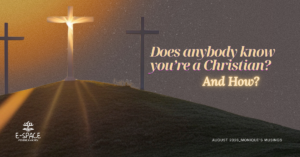
Does Anybody Know That You’re a Christian? And How?
Today is a faith anniversary for me. Four years ago today, in 2022, I was baptised. It was not the beginning of my Christian life. I gave my life to Christ in 2007. But that baptism felt, in many ways, like a rebirth, a recommitment of my life to Christ and a conscious decision to say again: Yes, Lord. I am yours. You can read more about that experience [here]. Four years later, I can say that God has done a great deal with that yes.He has grown me spiritually, certainly, but not always in the ways I imagined spiritual growth would look. He has dared me. He has challenged me out of my comfort zones. He has made me revisit some of the contracts I thought I had made with Him and question whether He had actually signed them too. He has challenged suppositions I mistook for convictions, and personal convictions I attributed to the will of God Himself. And, perhaps most uncomfortably, He has shown me again and again that in many situations where I was very sure somebody else was the problem, I was, in fact, part of the problem. All the ways I need grace and have been called to be perpetually dependent on Him. And He has been patient with me. So I have decided that my baptism anniversary is something I want to mark every year, not merely as a celebration of what happened that day, but as an opportunity to look again at my walk with Christ: where I have grown, where I am resisting growth, what God has been teaching me, and perhaps what He has put on my heart to share. This particular word was put on my heart much earlier this year, and I will begin by insisting this isn’t an attack on Christian fellowship, because perhaps “attack” is the wrong word to use. But it is certainly a calling out; a calling out of us all, as a people to whom I belong. So, if “iron sharpens iron” (Proverbs 27:17), consider this my small attempt at sharpening. I pray it reaches whoever needs it, because I see a great deal of cognitive dissonance in contemporary Christianity. I see us finding elaborate theological explanations for behaviours that, when stripped of the Christian language around them, seem plainly contrary to the love Christ commanded of us. And while God is not the author of confusion (1 Corinthians 14:33), I also don’t think we can “faith” our way out of contradictions that are staring us in the face. We cannot slap Scripture onto cruelty and make it holy. Let me state my key point: Christians, I think we have become very confused about whom we have been called to police. If you read the Gospels carefully, really listen to the Gospels of Christ, one thing that stands out is who Christ spent a great deal of His time speaking to and, importantly, who He rebuked; that is the Jews. His own people.He did not spend His ministry talking about how unholy the Samaritans were. In fact, when somebody asked Him who exactly counted as a neighbour, He made a Samaritan the hero of the story (Luke 10:25–37) which likely irked some people. He did not spend His time cataloguing the unholy practices of Gentiles and talking about all the ways in which they were falling short of Jewish law. No, rather, He spoke to the Jews because the Jews had the Word of God. They were the chosen ones. They had the law. They had the prophets. They had the rules they had been given to follow. And what Christ repeatedly confronted was the way they had twisted those things, the way they followed some rules and ignored others, and particularly the way religious authority could be used to burden and abuse other people. Some of Christ’s harshest words, in fact, were reserved for the religious leaders. Matthew 23 is almost uncomfortable to read when you remember that this is Jesus speaking. “Woe to you, teachers of the law and Pharisees, you hypocrites!” He says, again and again. He tells them that they tie up heavy burdens and put them on other people’s shoulders while being unwilling to lift a finger themselves (Matthew 23:4). And then He tells them that they have become very meticulous about certain aspects of the law while neglecting “the weightier matters”: justice, mercy and faithfulness (Matthew 23:23). In many ways I think the church in its religiousity is currently doing something very similar.We can become extremely particular about unChristian ‘worldliness’ while becoming strangely flexible around justice, mercy, faithfulness and love which are Christlike traits. One of the most poignant Christian lessons I have received came from my sister-friend Lily Haritu. I remember asking her what she thought about a particular practice among unbelievers. I don’t even remember what the practice was anymore. But I remember her response. She basically said: “But that is not for you to condemn“. She would go on to explain that they are unbelievers. They have not professed Christ. They have not taken on the faith you have taken on. You are not called to police them into obeying the rules of a God they have not chosen to follow. What we are called to do is correct those within the faith, lovingly, yes, but correct them. And to those outside the faith, we are called to show Christ. To testify. To live in such a way that somebody might actually want to know this God you say has changed your life.Years later, I realised how scriptural what she told me was. Paul says it almost bluntly in 1 Corinthians 5:12: “What business is it of mine to judge those outside the church? Are you not to judge those inside?” I mean, it is right there, and yet I feel like I see the complete opposite happening these days. Most of our sermons are about the sinfulness of the world around us,