
How are you? How is Women’s Month treating you?
Permit me tell you a story.
One of my clearest memories from my undergraduate studies was of an assignment that required us to write on cultural practices which were abusive or violent towards women. We were encouraged to speak to older women, like our grandmothers, who would be more aware of our specific cultural traditions. As my grandma is no longer with us, my source would be the mothers of some family friends. One from a Southwest tribe and another from a Northwest tribe. I asked the former to tell me about the practice of Female Genital Mutilation (FGM), and with the latter I discussed the practice of breast ironing.
It is worthy to note that both these women looked down on my studying Gender Studies. While they enjoyed empowerment particularly a woman’s right to work and earn her own money, they like many others, didn’t like the word feminist and disliked any studies which promoted it. But they were willing to answer my questions.
And thus while in the course of discussions with them, I brought up what I already knew. The practice of FGM was undoubtedly painful and while it claimed to ensure a woman’s ‘purity’ what it really aimed at was ‘curbing promiscuity’ by making intercourse an ordeal for the woman and in sewing up the sexual orifices (making them tighter) ensuring more pleasure for the man. The grandmother I spoke to did not deny this. She said she felt the practice was archaic and very dangerous with the poor sanitary conditions and prevalence of HIV- yet she could not really agree with what I said. She asked me “Are you saying it is a man that got up and decided that women should be cut like that? Are you sure? Why is it that it is women doing the cutting if the only beneficiaries are men?”
Similarly when discussing with Grandma Number 2, I recounted my knowledge thus far on breast ironing. The practice was one where young girls had their budding breasts crushed with pestles or grinding stones (sometimes heated) to discourage the growth spurt. The reason was simple, the longer their breasts remain small, the longer they remained protected from the lustful gaze of men. This abuse was supposedly an act of protection from male predators. Rather than attacking the men with pestles (pounding predators and child molesters with pestles between the legs would be good) the would-be victims were attacked. Here again this grandmother said to me “you’re right, but I have always wondered why don’t the mothers think what they are doing is wrong. Why are they pounding on their children rather than the would-be predators?”
At that time I couldn’t answer, but several years later I can. The answer is simply internalized sexism. The worst, and as I have recently witnessed, the most common type of sexism in Cameroon is internalized sexism.
Let me offer you a simple definition: Internalized sexism or misogyny is the involuntary belief and acting on beliefs of sexist stereotypes about women by other women.
It is simply women being sexist to one another because they have been socialized to believe that certain things are wrong for certain genders or socialized to believe other women are a threat etc. You see the women who advocate for FGM are assured, they believe that the practice would ensure their daughters would remain ‘pure’. They believe that women (always the other woman though) are promiscuous and to ensure that you won’t be you need to be circumcised. They believe it so they readily act on it.
Fast forward to recent times. Cameroon social media spaces have been abuzz with the Nathalie Koah and Eto’o Fils scandal. In all of that, the majority of both men and women of course dragged Ms. Koah through the mud. She has been called a slut a gold digger, a home wrecker etc. Women often dragged her more than men did. Another case of Internalize misogyny. You see we’ve been socialized to see a woman’s philandering as more offensive than a man’s. Forget the fact that they man was in a relationship (or even married) and the woman was not. How dare she be so cheap? What was she planning? Did she think he would leave the good woman he had for someone as cheap as she? Women said these things. Often considering NK the other woman, the Jezebel they had been warned about. The one we have been socialized by countless Nollywood films to pray against, No one it seems bothers to pray against the philandering man. “Men are weak”, they say, like dried fish soaked in water. They break down easily. And so it goes with internalized sexism, you buy into a stereotype that women are supposed to be a certain way and when they are not you criticize them three times as much as you would the opposite sex that failed you.
Internalize sexism is common, it is the voice of your mother or aunt which resonates from your teens warning you not to “tell your girlfriends everything”. It is the result of the constant competition girls are put up to-“Don’t you wish you had Jennifer’s shape, Annick’s butt, or could dance like Sandra? See as Rachel married quickly, it’s because she can cook….”
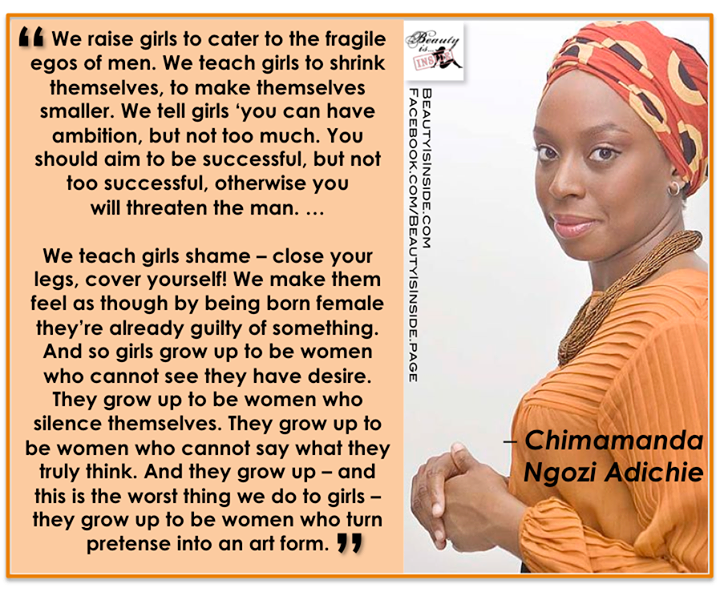
Internalized sexism is almost intrinsic to us, unless you’re really aware of yourself you won’t catch it. You would feel threatened by your maid and permit her cook a meal for everyone at home but for your husband- he must eat on your food. You would see another woman applying for a job in your office and sabotage her, they might end up liking her more than you. You would say I don’t like that woman because she smokes whereas the reason you don’t like her is because you’ve been raised to consider smoking unladylike and yet not be fazed by a man who smokes. You would say that girl is not a good role model she has had to many boyfriends, yet the fact that you judge her is because you’ve been taught that have more boyfriends than can be listed on one hand is a sign that you are cheap. Still you might need all fingers and toes to count your husband’s girlfriend (before university).
We don’t see the double standard when we do it, but we need to.
Every year despite there being an international theme for International Women’s Day (this year’s was- Planet 50/50: Pledge for Parity) Cameroon still coins up its own theme. Ordinarily this would annoy me, but I felt this year the national theme of: “Challenges and achievements in the implementation of the Millennium Development Goals for women and girls” was on point, because quite frankly we needed to make an honest assessment of ourselves.
We need to stop acting like the battle has been won- it hasn’t. There are several challenges and at the forefront of those challenges are our own selves. We need to address our own internalized sexism just as much (if not more) than that which we experience from the opposite sex and institutions regularly. Because if a man told you that you should be aspiring after marriage as your ultimate, you would call him out. So why is okay when your aunt sows the same thoughts in your head?
Like the women who pound the breasts of their children rather than attacks the adults who would abuse them, so are the wives who would go attack another woman rather than their cheating husbands. Those women didn’t make (and break) vows to you.
And have you noticed this rarely occurs with men? Because they have been raised with a lot more confidence, less self-doubt and comparison despite a terribly round belly you would hardly hear a man ask “Do you think I’m fat” Just as you would rarely hear a guy attack another man having an affair with his wife (not saying it doesn’t happen- just rarely). Back to the NK/Eto’o scandal as an example, how many guys did you see call out Eto’o as a cheat? Few if any I’m guessing. We could all say NK was wrong and a “bad woman” but you’d be hard pressed to find a man who would drag his brother. It is common knowledge that the brotherhood is strong. It is almost as thought there is an unbreakable vow taken among men: you will never tell a girl your friend is cheating on her…. yet with women the vow bends and is twisted to “well you could tell him if you like him,,,
Some might say we’re being “good” telling on one another, but is that all it is?
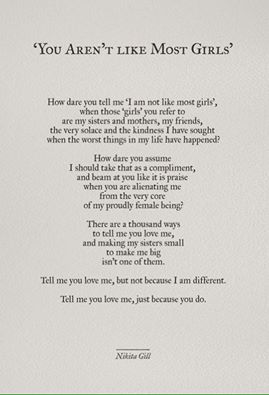 The majority of us have acknowledged that there is a problem. That there are gender inequalities. What we need to realize next is that we aren’t going to solve these problems singularly. We need to realize that in making statements like “Most of my friends are boys because I don’t like drama” or claiming “I’m not like other girls” as though other girls were a homogeneously flawed group we have to separate ourselves from- we further encourage those stereotypes.
 We need a sisterhood. A strong, vibrant, conscious one.No I am not saying we should support women just because they’re women- but rather that we ought to question ourselves and make sure we aren’t reacting as we have been socialized to before you drag a sister down. Ask yourself, would I be okay with this if she were a man? And why?

14 Comments
[…] more valuable, worthy of respect and fair treatment. And this is the reason we women love it, we are very much part of the structures which oppress us and our own internalized sexism loves the i…. Feminism advocates that we all be treated equally. All humans are beautiful in their own way and […]
I absolutely love your comment. Thanks for sharing your experience.
Hi Monique thanks for this elaborate break down.
I don't support Adultery.
I acknowledged Nathalie Koah's courage and kindness. From the moment she sent out a public letter apologizing and also advising other ladies not to buy into the mirage.
Trust me I didn't know the detail of the whole saga.
I will always refer back to this article because Nathalie made her self the voice of the voiceless. Till today Eto' hasn't even apologized. My guess he will do it after the MTN publicity knowing he has supporters.
Yes, I was one of those who believed Eto was a saint in this matter but after that letter I said what could have gone wrong NK. I didn't even know more of the details all I was aware was she was locked up.
I didn't take into account the rumors I heard that Eto has numerous girlfriends.
In my life I thank God for His Grace. When you are naive you think the best of everyone. But when you have God you have to listen to his Voice.
I have seen many girls who do their high class life coded and try to set me up. Try to make me be part of their world. I wondered you know it's not good why paint it glorious. So for NK to actually expose the truth and warn people in that letter. I was like she is courageous and kind. Which is rare. Life has taught me always support the truth. This is because one day one day the same scenario will knock on the door of those who support injustice.
Your article is so on point. The minute I made my support for NK it was amazing the education I got about adultery in boxed to me. I just smiled to my self and ignored them. We talking about abuse here not adultery.
Now those ladies who were insulting NK amazed me. This is because these girls use to do the same thing as NK. The also had their father's talk in public degrade their wives, the list is endless.
So you actually nailed it on point some of these ladies are so messed up in their subconscious mind that they see abuse as the norm. They see the double standard as the norm.
It's not only an African thing. The rest of the world are opening up to these double standards.
I will encourage ladies to please fellowship with God and know that you are loved. And love yourself.
I also think the men need to be nurtured. At a young age men are disciplined hard. And to an extent most of these men have a different perception on how to get their way; hard.
They don't know love and take rejection hard.
super blog post
Thank you all for reading, relating, and sharing. Cheers to sisterhood!
Monique you said it all. Well done!!!! It's high time we women become each other's keeper instead of pulling each other down.
Sexism is everywhere, even here in u.s the greatest country in the world, we all agree but if you are already taking side towards Nathalie koah, I am sure you made enough research on that before making that citations. We also would love to read about your findings
Sisters, we need to love each other, support each other and be less judgmental of each other. Let's stop being our own greatest enemies. Together, we are better and stronger. Let us take a cue from the brotherhood. Well-written piece, Monique.
Precious Core Blog
Wowwww God bless you Monikie. Beautifully written. And trust me this are all facts. A perfect case was that of Nath and Eto'o. Welldone. Long piece but worth reading
Internalised sexism. I used to call it racism against ones own sex. Thank God theres a better word for it. I agree completely.
Its a big problem in Africa.
Nice piece Monique. Thank you for telling it as it is. We all need to learn from this
Monique. God bless you. May the desires of your heart come to pass. Chai. I no know thing for talk again. Thank you for writing this. We needed it. I've been having these conversations with my friends.
I hope women read this with an open mind and start to recognize their blind spots and call each other out.
Deep and very well written. Much food for thought!
Beautiful. I flowing with you sis