For Cameroonians who are wondering what next?

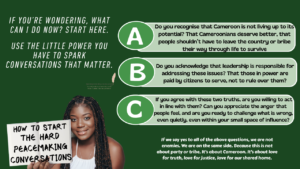
Tensions are rising. And while I can’t call that a win, I can say it’s understandable, maybe even necessary. Before sharing this, I had to pray. Because this isn’t about me, it’s about sharing a lesson that’s been growing in my heart for the past year, one that the Holy Spirit has been teaching me through my anger, confusion, and faith. Last year, when Trump won, I was deeply angry, less about the outcome and more about what it revealed about humanity, and the way Christianity was being warped to legitimise a regression into hate. But God showed me the unexpected benefit in this: some things have to come into the light before they can be healed.What we’ve been witnessing, the rise of the far right, the open displays of racism, sexism, and intolerance, etc., these things didn’t appear out of nowhere. They were already there, festering in silence. Those who called themselves “liberal” or “progressive” thought they were winning, but were only louder, not more convincing. People’s minds weren’t changing; we had just learned how to drown out discomfort with better PR. And so, God helped me appreciate (not like nor enjoy) that injustice, hate, and hypocrisy are rising to the surface. It is not only proof that the world is falling apart, but also proof that the sickness is finally being exposed. Because sometimes, the only way to confront darkness is to let it come into the open. You can’t cleanse what you won’t name. I am sharing this lesson from the past year, because I find it particularly valuable to where we are now in Cameroon. Many are upset by the unrest and are “praying for peace”, but too often what we mean is silence, a return to comfort. Because peace without justice is just silence. It’s the quiet that comes from people being too afraid or too exhausted to speak. That’s why I’ve stopped praying for “peace” in the shallow sense. Too often, when we say Father, give us peace, what we really mean is make it quiet again. We want normal, even if “normal” was rotting underneath. But real peace is not quietness; it’s justice restored. The Bible says, Blessed are the peacemakers (Mathew 5:9). Peacemaking is not passive. It’s work. It requires strategy and courage. You can’t make peace unless you first admit there isn’t any. That means naming what’s broken, confronting what festers, and having the uncomfortable conversations that move us toward healing. So if you’re praying for peace, pray also to become a peacemaker, someone willing to have hard conversations, to think critically, to challenge what’s wrong even in your own home. Because peace won’t come from the top down; it starts with us.As I said yesterday, until we start calling out our friends, our uncles, our chiefs, and the elders in our own circles who benefit from upholding this system, nothing will change. This isn’t just about one man or a few men up there. The system survives because of what we have accepted, played into, and kept silent about. And I know many people are thinking they are powerless today, after the declaration of those results and with the spread of violence. But that’s a lie. A dangerous one. That’s one of the biggest lies we’ve been sold. My favourite Alice Walker quote says: “The most common way people give up their power is by thinking they don’t have any.” You do have power.If you’re raising a child to be civic conscious and to shun ethnic bias and other divisions, you’re shaping a future mind, that’s power.If you can speak up, write, and influence others with your platform, that’s power.Even having difficult conversations is a power. You have power over what you allow to slide unchallenged in your circle. You only lose your power when you say, “What’s the point? Nothing will change.” Many of us are tired and resigned right now, but we still have some power. I’m inviting us to start from where we are. Talk to the people closest to you, especially the ones who think differently, who still believe the system works. You have the power to engage those you disagree with, who you know are complicit in keeping us all down, or who don’t know better. Let’s address our own, speak to that uncle who got you your job through his connections with the party.Address that elder in your church who excuses their participation in this system. Let’s have an honest conversation with the colleague who says, “That’s just how Cameroon is”? This is not about attacking anyone. It’s about peacemaking, the uncomfortable, confrontational and patient work of helping people see differently and finding common ground. Because if we are honest, the greatest evil this government has perfected is divide and rule.Francophones against Anglophones.North-West against South-West.Christians against Muslims.Each of us is taught to see the other as the problem. But the truth is, this system harms us all. Even those in power — they, too, are trapped in a machine that feeds them crumbs while robbing everyone of dignity. We need to acknowledge this division for what it is, a tool of control, and find our way back to common ground. So if you’re wondering, what can I do? Start there.Use the little power you have to spark conversations that matter. There’s a technique I use with my students when teaching feminism, and it works for complex topics too: ask questions that make people think. If you know someone who supports the current regime, talk to them. Pray first (genuinely) so you speak with calm and compassion, not anger. Then ask: 1. Do you recognise that Cameroon is not living up to its potential?That most Cameroonians deserve better, that people shouldn’t have to leave the country or bribe their way through life to survive? 2. Do you acknowledge that leadership is responsible for addressing these issues?That those in power are paid by citizens to serve, not to rule over them? 3. If you agree
Read More »

On post-elections Cameroon, and the Dangerous Death of Hope

Years ago, I began using the hashtag #MakeCameroonHopefulAgain. People thought it was a mockery of “#MakeAmericaGreatAgain”. It wasn’t. It came to mind as I thought of what we needed most. We need hope. I write this having just concluded a conversation with a friend where we discussed our sadness at another sham of an election in Cameroon and the violence already spreading. Something she said reminded me of a video I saw recently, one that explained why Gaza matters so much. Now, I know many Africans hear that and go, “Abeg, we have enough problems of our own; Congo, Sudan, Cameroon…” And they’re right. Others counter that the world isn’t even talking about those places with the same energy, and they’re right, too. Both thoughts are valid. But that video said something that struck me and has made me appreciate Africans like Zukiswa Wanner taking Gaza seriously (read about her experience HERE). There’s something about Gaza that demands attention, not because it’s more tragic than others, but because it exposes one of humanity’s most dangerous delusions. That delusion is the belief in the perfect victim. We’ve been taught, through religion, through moral philosophy, through the selective histories on Martin Luther King Jr and Mandela, that if we are peaceful enough, patient enough, and innocent enough, the world will recognise our suffering. That if we document the injustice, appeal to conscience, show the evidence, people will do better once they know better. Gaza is a brutal contradiction of that belief. We have seen everything: the bombed hospitals, the dead children, the journalists silenced, the white allies targeted, and the churches and mosques alike destroyed. It has been filmed, documented, and verified. All the UN agencies have called it a genocide. And yet, the killing continues. If “doing everything right” still ends in annihilation, what happens to people’s faith in peace, in reason, in humanity? I think back to Nigeria in 2020, and the way I felt after the Lekki Toll Gate massacre. We watched that live, too. We saw the lights go out, and the soldiers open fire on young people singing the anthem. The #EndSARS protests may have been violent in many places, but in Lekki, where most are middle- to upper-class, there was a DJ playing music. That’s as peaceful as an African protest can get. It seems like a very resolute party with young people singing, and mostly on their phones. They still got shot by the army, the same army they fund through their taxes. And years later, one of the men responsible is now the president of Nigeria. What message does that send? It didn’t matter that we knew; it didn’t matter that journalists printed evidence of his other crimes. It says: evidence doesn’t matter. Some people can get away with it. Just as their guilt doesn’t hang them, so too, your innocence doesn’t save you. Do you see the issue? The danger? Now, let’s think of Cameroon. If we think critically, we have already seen this thing play out in Cameroon, with a horrific end. The ongoing Anglophone crisis didn’t start with what we now call “Amba”. Before that, there were teachers and lawyers, peaceful, moderate people asking to be heard and for legal systems to be respected and issues addressed. And they were mocked, arrested, and belittled. When you crush the moderates, when you show that peaceful protest and following due process means nothing, you create a power vacuum. And in that vacuum, beasts rise. That is how we now have the scourge of Amba and a people turned on themselves. People keep saying the Anglophone crisis became violent because guns got into the wrong people’s hands or drugs spread among the youth. But no, before the guns and the drugs, hope left their hearts. When people no longer believe that the peaceful path works, when they no longer trust that justice or accountability exist, what else do you expect them to become? You kill the last bit of hope people have in dialogue when you turn dialogue into a bureaucratic charade (see the 2019 “national dialogue”) and use peace marches for your selfish ends. And once hope dies, people devolve. They stop caring. And here we are, seeing the same thing happen again: people’s cries are being ignored in other regions, and the evidence the masses put together is being ignored. We have seen videos of electoral fraud with no accountability. If we keep letting that happen, if we keep mocking peaceful efforts, silencing reason, and ignoring evidence, then we are the ones feeding the beast. As someone who witnessed the crisis go haywire and spoke up against it from the start, this is a perilous spiral. You cannot control the beast; it turns on anyone and everyone. I’m writing this as a follow-up to a video I shared earlier to make a note, because I am noticing a pattern. People are losing faith in processes, in justice, in peace. And when hope goes, violence rises. In fact, violence has risen, and we must acknowledge that it is not because certain people are just violent, but rather it is evidence of increasing despair. Despair is the beginning of chaos. So please, let’s not joke with the widespread expressions of despair. Protect hope.It’s not sentimental, it’s imperative for survival. Before guns get into more hands, let’s make sure hope hasn’t left their hearts.

Read More »

Earlier This Year, I Was Asked About Cameroon’s Politics. Here’s What I Said…

In January of this year, I was invited by Line Sidonie Talla Mafotsing to share my reflections on Cameroon’s political culture, our history of leadership, and what lies ahead as the country prepares for elections. Unfortunately, it appears that she can no longer publish the piece for which I was interviewed. Nonetheless, I remembered the conversation and how I spoke candidly about what we have normalised as a nation, the muted sense of agency many of us feel, and much more. I’ve decided to publish some of the transcript here on my blog because the interview gave me space to think more deeply about history, memory, silence, and the guardrails we must build if we want change to mean more than just a new face at the top. And as we head into the month where we’ll be seeing yet another (sham) of an election. These words are all I have for now.

Read More »

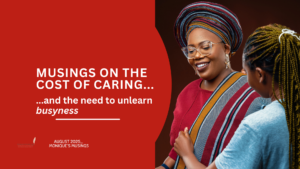
Musings on the Cost of Caring… and the need to unlearn busyness (Aug 2025)

They say it costs nothing to be kind. But it does. It costs a lot. I can’t only be kind with words. I have to be kind with actions. I have to be kind with my time. I have to be kind with my energy. And all of those cost something. Attending a child’s birthday party means I need money for transport, I need money for a gift, and I need the well-being to show up and actually be present. Even just giving someone a smile requires that I myself am okay. How do I smile when I can’t afford healthcare? How do I stand up to injustice when I’m already exhausted, working three jobs just to survive? Kindness costs. Caring costs. Humanity costs. And those in power know it. They have always known it. They bank on it. They keep building on systems of inequality because nobody interrupts them. The people who might have disrupted it before us were busy trying to survive. Just like we are busy now, and because we’re busy now, they will keep accumulating, and it will get worse in the future. Today we decry the glaring inequalities with the wealthiest 1% owning almost more than half the world does, but Elon didn’t get rich today, he was given the tools generations ago. These billionaires had the systems already in place, and because nobody stopped them then, we can’t stop them now. Humanity costs. And you know what? Upon reflection, I believe the greatest evil, the most significant threat to humanity, isn’t even the billionaires or the politicians. It’s our busyness. That’s the real enemy. It’s the way capitalism has cultivated a culture of individualism, where we’re constantly occupied and constantly trying to survive. Because as much as I want to help, I can’t help when I myself need help. So people postpone caring until it’s convenient. We postpone showing up at protests because we have to clock in at work. We postpone resisting oppression because it’s hitting someone else first, not us. We stay busy until it comes knocking directly on our door. Our occupations are the biggest threat to our humanity. And they know this. They know we cannot afford to care in a capitalist system, so they keep us anxious, they keep us hustling, they keep us busy. I remember one time I was in a clando from Buea to Douala. The driver got stopped, as usual, by gendarmes looking for a bribe. They started nitpicking at his papers. He had already paid money at so many stops that day, and he got angry. He said, “How much do I even make on this route if every time I pass, I give you something?” He refused. He was furious. But the gendarmes just stood there, waiting. And one by one, passengers started getting out of the car. They didn’t want to be delayed. They didn’t want trouble. And I understood them. I was quiet at first. But then I saw the gendarmes watching, amused, knowing the driver would eventually cave in, because without passengers, he’d lose everything. And I thought to myself: this is exactly how oppression works. They bank on our time, our impatience, our busyness. That day I decided to stay. I stayed in the car. Just one other passenger and I did so. And I said to myself, I’ll try to cover the cost of one other passenger who left, I’d pay for that seat, so the driver wouldn’t lose everything. The money was a sacrifice, but the look on that man’s face… I’ve never forgotten it. I recall tweeting about it at the time. He needed our presence so that it wouldn’t look like his defiance was madness. That day taught me that resistance requires time. Resistance requires forfeiting comfort. It requires staying put when it would be easier to leave. And not everyone can afford that. It reminded me of another moment, in 2017, during the protests at the University of Buea. In a meeting, the administrators were giving the Vice Chancellor their account of what had happened. They were blaming the students, blaming ethnic groups, twisting the truth. I sat there listening, afraid. And then I opened my mouth. I said, “That is not what happened.” I corrected the story. My heart was pounding. I was so afraid that I secretly called a friend on WhatsApp and pressed record so there would be proof of what I said. Later, I told my godmother about it, and she said something I will never forget: “That was a privilege.” And she was right. I was young, single, no children, no dependents. If I lost my job, I could try finding another one. But for my colleagues with families to feed, parents depending on them, the cost of courage was too high. It wasn’t that they didn’t care. It was that they couldn’t afford to care. That is the reality of capitalism. That’s the reality of our world. Life doesn’t give us margin. You may care deeply about Palestine or Congo or Sudan, but that doesn’t mean you can sacrifice your child’s school fees for the cause. You may want to protest, but you can’t risk losing your job. You may want to speak truth to power, but you know it won’t only cost you; it’ll cost everyone who depends on you. And so, some people fight from within the system, while others choose to leave and love their country from afar. And I’ve learned not to judge either choice, because both come from the same truth: humanity costs, and not everyone can pay. But here’s the part that scares me the most. The powerful know this. They count on it. They count on our busyness, our fatigue, our survival. They count on us not having the privilege to resist. And as long as they can keep us in that state, they will continue to win. So when people say kindness costs nothing, I shake my head. No.

Read More »

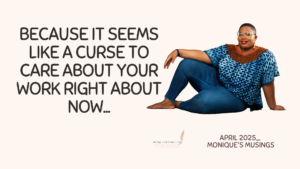
Because it seems like a curse to care about your work right about now… (April 2025)

For as long as I can remember, I’ve been drawn to people who care deeply about what they do. That’s been one of my identifiers for quality people: do you feel something for your work? Do you care enough to want it to matter? Because doing meaningful work requires you to care. Whether you’re launching a product to make life easier, teaching in a classroom, or writing research to inform policy, you have to believe that what you’re doing holds value—that it can lead to something better. And caring people value themselves and others… But lately, caring feels like a curse. Maybe it always has been, but it’s worse now. Feeling has become heavy. Only those good at compartmentalising (I truly envy you) can stay sane. Because the more conscious you are, the more you notice how little your work seems to matter. How do you keep showing up when everything feels like it’s falling apart? How do you teach justice when injustice is the norm? How do you keep researching when those in power have no intention of using that knowledge? And so my belief that work should be meaningful, which has fueled my career and life, is at this moment also what’s breaking my heart. And bringing me to the brink of a depressive episode. Why am I sharing this here? Well, LinkedIn used to be a space that showcases passion for ones [meaningful] work not just the wins as it seems now. Here we could see insights and growth. But scrolling now, I find that even the shiniest updates carry exhaustion. Beneath the achievements, there’s a quiet despair: our work is losing its meaning. As someone who works on education and social justice for development, I’m increasingly haunted by how disconnected knowledge is from action. We’ve theorized inequality to death. But even the little effort towards implementation we were making (remember all those equity and inclusion statements?) is being undone less than five years later. Because funding. Because politics. Because profit. So I ask: what’s the point of knowledge if those in power won’t use it? If it doesn’t make them money, or if they just don’t care?And this isn’t just academia. Every field, be it business, tech, health, the arts etc. is caught in a battle between purpose and performance, between meaning and metrics. I recently read a paper [my first “just because” academic read in a long while] that asked: Is scholar-activism an oxymoron? The fact that this is even up for debate made me shake my head. Shouldn’t scholarship always have been activism? Not necessarily in the marching sense, but in the pursuit of truth and justice? If not for impact, what’s the point of all this knowledge generation? Are all these citations, all these conferences for vibes?Maybe. Because clearly, we’ve drifted. We’re no longer doing meaningful work. We’re doing measured work. Ranked, rated, reduced. And that, to me, is the real crisis. There’s so much knowledge that could change lives. But who will use it? More importantly, who will be held accountable for not using it? So I’m writing this here because I’ve wondered about my own melancholy over work I chose and genuinely love. But it’s clearer now: as the work loses meaning, so does our vim. And that’s why I’m tired. Deeply, soulfully tired. It’s not normal to witness crisis after crisis and be expected to show up as usual. It’s not normal, and that’s why we’re exhausted. Constantly. I know saying this might not be the most “LinkedIn” thing to do; not here where we’re all high-achieving and always inspired LOL! But we owe ourselves honesty. I’m tired of talking about change and seeing nothing change. What keeps me going is the faint hope that maybe- just maybe- what we do now will matter later. That someone, someday, might stumble upon our work and use it to shift something. Like how that Lizzo song started to trend years after it came out, finally making her famous, maybe the paper we write today might not go anywhere till someone who cares comes to power and uses it for policy tomorrow. That hope… and, of course, the need for a paycheck, is why I keep showing up. If you’re feeling the same- disillusioned, angry, heartbroken… know you’re not alone. I believe there’s quiet a number of us of us out here. We’re trying our best to still care. Even when it doesn’t make sense. Especially then.

Read More »

Why a Black Pope Isn’t Necessarily Progress—and Why the idea Makes Me Uneasy (May 2025 Blog)

** In the past week, I’ve seen so many posts and comments from contacts eagerly awaiting the results of the ongoing Papal Conclave, hoping for a Black pope. A few days ago, I shared my own unpopular opinion on the matter: I really would prefer the new pope not be Black. First off, it’s not because I agree with the white nationalist nonsense about not wanting “a DEI Pope.” Far from it—I absolutely detest that thinking. But I know that if one of the Black or Asian contenders were chosen, there would be backlash. Many would assume that diversity politics had somehow “won” over tradition, and that assumption alone would make life harder for the new pope. If you’ve ever been a diversity hire for anything, you know how much pressure such a pope would face to constantly “prove” themselves. I wouldn’t wish that on anyone. I should also note that I’m not Catholic, though, thanks to a few years of Catholic schooling, I’m somewhat familiar with Catholic doctrine. My issue here isn’t with Catholicism as a faith, but with the Catholic Church as an institution. Christianity, to me, is about your relationship with God, your faith, and your communion with Christ. But being the head of the Catholic Church isn’t just a spiritual role—it’s leading a system that, despite its spiritual mission, has a long history of aiding, abetting or actively partaking in the marginalising of historically oppressed groups. The recently deceased pope acknowledged some of these flaws and made attempts to address them, and I believe he managed to do so because he was white. A Black or Asian pope, on the other hand, would face far more scrutiny for taking similar steps. Either way, putting a Black person at the head of that system right now wouldn’t magically fix its issues. Instead, it would force that person to defend the system’s history of abuse of people who look like them. My perspective on this comes from seeing this happen elsewhere. It’s not just about the Catholic Church. We see this pattern every time women, Black people, or other marginalised groups are put in positions of power without any real systemic change to the institution they now represent. The problem with simply placing a minority or someone with a marginalised identity in a leadership role is that it often ends up being symbolic, representation without transformation. Worse still, if that person isn’t critically conscious of their position and the institution’s flaws, they can end up perpetuating the very harms they were supposed to challenge. Think about it: what real power would a Black pope have to address the Catholic Church’s problematic history? What repercussions would they face if they actually tried to dismantle the system’s oppressive structures? Isn’t it more likely that they’d end up serving as a convenient shield for the institution—a way for the Church to claim progress without addressing the root issues? We see this in other contexts. For instance, the current UK Foreign Minister is Black, but has that meant more critically conscious foreign policy decisions that address the UK’s role in marginalising the majority of the world’s Black and brown people? Has it made him more likely to discuss reparations? I don’t think so. Likewise, in Cameroon, appointing Anglophones to high government positions hasn’t solved the Anglophone problem. It’s not just about whether marginalised people hold office—it’s about whether the system itself becomes more inclusive and just. Putting an Anglophone in a position of power doesn’t automatically fix the systemic issues. Sometimes, that person even becomes the face of the very problem they’re supposed to be solving. My work with feminist advocacy taught me this the hard way. We push for women to enter certain leadership roles because representation matters. But I’d rather see a feminist man in a position of power than a woman who doesn’t care about women’s issues. That feminist man will know when to step back and make space. Meanwhile, a woman who does not acknowledge patriarchy and its dangers might uphold the same harmful norms, or do even worse because she feels pressured to prove herself. Diversity, equity, and inclusion can’t just be about changing faces at the top. We need to acknowledge that the real problem is systemic and what the odds are for that person to change that system, because racism, sexism, ageism, ableism, and other biases are embedded in these institutions; they are the knots and bolts of the tables we so want to have a seat at. So, while I understand the desire for a Black pope, I’m wary. True progress means tackling the system itself, not just changing the face of leadership. Without that, we’re just setting up marginalised leaders to fail—or worse, become the face of the very practices they were supposed to challenge. ** This was written shortly before the announcement of the new pope.

Read More »

A Conversation with Nayah Ndefru

A few months back, I had a conversation with Nayah Ndefru on her Podcast “Breaking the Code” where she gathers her networking to discuss breaking the variety of toxic cycles plaguing us individually and socially for a better quality of life and fulfilment. Watch/listen to our conversation below.

Read More »

What is happening Cameroon? II

Dispatches from home read like material for a great historical fiction manuscript. You easily imagine the Whatsapp voice-notes with either news of military abuse of power, chilling threats from frenzied ‘Amba’ fanatics, or worse, news of yet another kidnapping or murder as something fictional characters in the 1970s would have listened to huddled over the lone radio in the house. Because this can’t be happening in now; in the day of intelligence readily manufactured as AI. It can’t be happening in the age of everything smart; smartphones, smartwatches, smart kitchen utensils, yet senseless humans? How can that be? But your inbox proves that it is, that anomaly is possible and real. Four weeks ago, you were informed that the military presence in your hometown has moved your old schoolmate (at the ripe old age of 30) to learn French, the language of the men in uniforms. So she now accompanies her 8-year-old daughter to the house of a teacher who now teaches kids on her veranda because schools are a no-go zone. Your cousin laughs as she tells you “Mo imagine o! If we had known, we would have paid attention to Monsieur Flobeh!” You reply to her statement with laughing Emoji but you think “If we had known, we should have made sure a lot more people paid attention to history lessons. A week later you receive a message from one of your friends-turned-sister as you arrive at your church for Sunday service. It reads: “Sis, I hope you’re well. Please pray for me oo! I received a call from a guy threatening me. He says I should support the movement or else they’ll harm my family”  You stand at the doors of the church, immobile but for your fingers readily typing up questions; when, how, why you? She says the call was brief but followed by an SMS of how she should make a deposit to ‘support the struggle’ and she was probably targeted as any other civil servant who people believe have money on the regular. You warn her not to even thinking of making any deposit, lest she is caught and the police arrest her for ‘sponsoring terrorism’. Your mom’s friend is in prison in Yaoundé at the moment on those charges. He had paid ‘Amba boys’ a large sum of money upon receiving threats of kidnapping. Your friend agrees that paying would be dangerous, she can only run away with her kids. You sigh as you read that, and head to a seat for a sermon you will not remember because you were crying silently through the preaching. To think this is what we have come to. When you return home later you check on your friend. She tells you that she’d had the idea to reach out to an acquaintance you both know,  a young slightly over-zealous Christian ‘brother’ who is known to have participated in some ‘Amba’ activities. She felt he could help verify if the threats were genuine or just a scam from thieves. And if genuine, she thought he could help her get off their targets lists or at the very least, he would see the error in the company he keeps. No expected outcome came to pass. She tells you that upon narrating her experience, our brother-in-Christ told her that he could introduce her to the guys collecting the ‘support funds’ and explain to them that she doesn’t have much so whatever she can give will be okay.  “Just give small money for bullets, sis,” he said. You are shocked. But not for long. You will soon hear that no one can be trusted to be rational now. That irrationality is a norm. You are told that a colleague you didn’t particularly like at your alma mater was attacked recently by ‘Amba boys’, their crime was being from the wrong tribe- Bamileke. Your tribe based on patrilineal traditions which won’t consider other factors of your identity. Suddenly, you feel bad for having disliked this person who is now a victim. You hear that some other colleagues, the educated, the elders at church, the fathers of young children had shrugged at the attack, they saw it as well deserved. After all, Bamilekes are neither here nor there so surely spies. At that moment you determine that Cameroon and its Cameroonians do not warrant your shock. The nation is simply living up to being considered a ‘shit-hole country’. In the days that follow, your inboxes belch out more: Black young men are now an at-risk species in the Anglophone regions, just like in the United States. Are you black, of average to tall stature, possibly aged 17- 30?  Then you could possibly be an ‘Amba boy’ and the police (with no questions asked- and even if asked, not in English) would profile you, arrest or possibly execute you at the least provocation. Your neighbor films her daughter, a toddler practicing her hiding technique. Like the fire drills in western schools. Except this is a four-year-old who now recognizes the sound of gunshots and how to hide under the leather sofa even as she has yet to enter a nursery school classroom. You’re told that one of your former neighbors is now fundraising. Asking all and sundry for help as her husband has been kidnapped. The boys asked for 10 million FCFA and the family negotiated the ransom down to half that price. You picture the bargaining over the phone and shake your head. How does one bargain on the life of one’s spouse? By last week, the frequency of the messages had increased, but not their content is different. “Mo I’m in Yaoundé now, I’m safe.” Or “Mo pray for us oo! I am hoping to leave to Douala tomorrow”. Their WhatsApp statuses show they’re okay, the proof is in their taking photos on the sides of the road with and there being no sign of military trucks. These ones had made it safely to the ‘other Cameroon’ despite the risk

Read More »

The Employment Problem Cameroonians Are Not Talking About

When we think of employment issues in Cameroon, we often think of the unemployment and how graduates can go for years looking for suitable work. We think of underemployment and how someone with a masters degree in rural development could end up driving a taxi We talk about the lottery-like national entrance exams into the civil service, the corruption, and tribalism that pervades the whole process.  But what about after employment? What about those who do make it past that line and then set the standard of mediocrity which is killing us as a nation? That’s what I’m musing on this month.  Check out the vlog below and leave me your thoughts in the comments!

Read More »

The MILEAD Experience

In 2015 I was selected as the MILEAD Fellow for Cameroon. The MILEAD Fellows Program is a year-long leadership development program designed to identify, develop and promote emerging young African Women leaders to attain and thrive in leadership in their community and Africa as a whole. The program selects 25 young women aged 25 and below who have illustrated potential as nation builders and ‘influencers’.  MILEAD offers them a chance to become part of an inter-continental network for professional and personal development, offers them a three week training in Accra, Ghana and challenges them to completed a transformational project in their communities upon their return home. As the program requires selected fellows contribute a percentage of their individual cost, I was compelled to do a fundraiser to support my participation. Alongside the the successful fundraising, and upon urging from Ngum Ngafor of Africally Speaking, I made vlogs on my MILEAD Experience. Here are three of those vlogs for your ease of access. Prior to take-off While in Ghana: And finally upon return home: It is hoped these vlogs inspire some other young Cameroonian woman to apply for the annual program. It is a truly life-changing experience; and I’ve got pictures to prove it!

Read More »