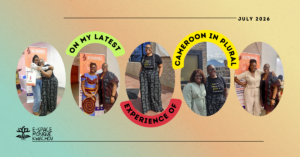
Throughout March 2026, I have been musing on and responding to a variety of feminism-related questions as part of a challenge from Lorraine Shu Media in commemoration of Women’s Month!If you missed following via my social media, here is a compilation embedded as a vlog. Links to AFF resources mentioned on day 30: English: https://share.google/fO8rVbCbkq6fxghTc French: https://wipc.org/wp-content/uploads/2020/03/The-African-Feminist-Charter-French.pdf
But, what if Cameroon’s greatest problem is… Love?
It is the month of love.Everywhere around us, love is being marketed loudly, particularly romantic love. Grand gestures. Gifts. Performative affection. All to prove that you love and are loved. As in past years, my musings for this February tie to this month’s theme, but rather than reflecting on a kind of love, I’m thinking of our (Cameroonians’) collective lack thereof. Because the more I sit with it, the more I feel that one of Cameroon’s deepest problems is not just the corruption, nepotism, tribalism, poor governance, or development failure we so readily name, but a lack of love. A lack of self-love, a lack of love for this country, and a lack of love for each other.I know this sounds soft. Romantic, even. Idealistic…There’s a scene from Harry Potter that I’ve never forgotten. In the final book, when Harry tells Voldemort that he will never understand why he cannot defeat him, Voldemort scoffs: “Is it love again? Dumbledore’s favourite solution?” And Harry basically replies in the affirmative; it is love.It seems like such a minor exchange in a children’s book, but it captures something profound: the tendency to dismiss love as weak or naive when confronted with what we perceive as “real” power or “real” problems. So I know someone reading my claim here will scoff and say, “No, Monique, we have real problems. Economic problems. Structural problems. Political problems.”And yes, I agree, we do.But even if those problems did not originate in a lack of love, they are certainly being sustained by it. Let me explain using an analogy I’ve used with friends in the past: If I come into your home and I see something beautiful, a display cabinet, for instance and how you’ve set up your kitchen, or a welcoming chair you’ve put into your living room, I will admire it. I will ask where you got it from. And chances are, I’ll leave your place planning to get something similar for myself. Why? Because I appreciated what you had, and I want my own space to look good too. That is self-love. Now think about this. We have people in power who travel constantly. They see how things work elsewhere. They experience efficiency, dignity, and beauty through various airports they frequent on official missions and luxurious vacations. Their kids reside in countries with roads that make sense and where they can take walks without seeing a pile of dirt on the road. And then they come back home. They see the dysfunction here. The chaos. The lack of care. And yet they do nothing. The majority of our leaders and our ‘1%’. are okay with their wealthy friends coming to their country to see it unchanged, poorly groomed, without care. If they truly loved themselves — truly — they would want their own things to look good. This is not even about morality. It is basic selfishness. A natural byproduct of a healthy ego. If you love yourself, you want the best for yourself. You want comfort. You want quality. You want to show off. And yet, even in our selfishness, we fail. We have people who steal billions, but cannot enjoy themselves properly at home because the system they refuse to fix still affects them. Do you see how a lack of self-love is at the root of our mess? And it’s not just the leaders who lack it; we as a people collectively need more self-love. Yes, we are underdeveloped largely as a result of historical injustices and oppressive global systems sustaining inequality. But the question remains: do we love ourselves enough to want better? Do we love ourselves enough to create standards and respect them? Do we love each other? Look at any African country that is prospering right now (note: I’m not saying they’re perfect); economically, they’re doing fairly well and progressing compared to Cameroon. If you go to these countries, you see a common factor: national pride. Literally everything in Kenya has the flag on it. Literally everything in South Africa screams “Mzansi”. Every other street is named after Nelson Mandela. Nigerians will criticise their country from one end to the next, but they are prouder than proud of who they are. Senegalese, the same thing. But we Cameroonians? We are proud in competition, and we have very little to compete with, so it’s usually shallow. You’ll hear other countries banter on Twitter, saying they’re so much better than us in terms of development, and a Cameroonian will retort, “But we have Eto’o!” (as if he’s not part of the problematic system). I can’t tell you how often I’ve been in the company of mixed nationalities and heard a Cameroonian put down Cameroon and other Cameroonians. A friend recounts being in a meeting where Cameroon was being considered to host the hub for an international programme, and a fellow Cameroonian dismissed the idea. It is crazy how little we love our own. How desperate we are to just leave the place. Nobody wants to really fix it. We have given up on it. It’s that lack of self-love that is sustaining the system. Yes, the system is already bad, but what is keeping it bad? What is making it worse? It’s our lack of self-love. Before coming to the conclusion that the lack of self-love is at the root of our problems, I thought ours was a problem of elitism. But the more I examined our elitism, the more I realised it was a symptom, not the disease. The elitism we practice and aspire to arises from the fact that we don’t love ourselves or each other enough to believe we all deserve dignity, and because our love, when we would have it, is conditional, reserved for exceptionalism. We don’t care that the system is bad. We just want to benefit from the system ourselves. We want to be the exception to the rule. We want to get into institutions like ENAM (École nationale d’administration et de magistrature) rather
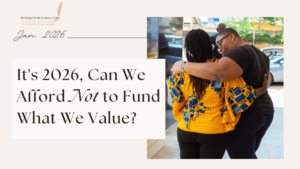
It’s 2026, Can We Afford Not to Fund Who & What We Value?
One of the biggest lessons I carry from my years of burnout is this: “heart work” still needs money. Last year, the international NGO and aid sector took a major hit. The aid world shook. Questions surfaced everywhere about whether aid should be reduced, paused, or stopped altogether; about whether foreign aid has actually been sustaining civil society work in Africa or distorting it. That debate is complex. I cannot summarise it in a blog post, and I do not intend to try. What has stayed with me, though, is something related and (in my opinion) less voiced. Even though research shows that foreign aid has never sufficiently funded grassroots care work, advocacy, and community labour, there was a widespread perception that “most of the work” was being sustained by external funding. The fact that we believed this even when it is not true reveals something dangerous: we have lost sight of who is actually responsible for holding up the work that keeps communities alive. This year, I want us to consider putting our money where our mouth and heart are. I want us to consider taking stock of who holds the purse strings behind the spaces and things we value. By us, I mean my Cameroonians first, and my fellow Africans on the continent next. You see, it’s more obvious in advanced capitalist societies in the West. Everything has already been commodified to a T. They know to wield their purchasing power to resist and protect. But in our context, I think we haven’t grasped it yet. But we must. As the world becomes more aggressively capitalist, as wealth concentrates, as everything is monetised, as care, art, and conviction are increasingly turned into “content”, it is imperative that we actively protect and materially support people doing essential work, or they will burn out, fail, or be forced to compromise their values. We must recognise that even (perhaps especially) work that is of the soul, any work that pushes against the system, in fact, any work that does not immediately translate into material value, but holds spiritual, humanitarian, artistic, or community value, still needs to be financially sustained. Because the person doing that work is still living inside a capitalist system. They still have bills to pay. They still have children to send to school. They still need to survive. I learned this lesson firsthand. For the first ten years of its existence, I ran Better Breed Cameroon mostly by myself and 70% out of pocket. I do not discount the fact that people believed in me and sowed into it, but most of that time, leadership and execution rested largely on my shoulders, alongside my doing a PhD, paid work, and life itself. As should be expected, I eventually burned out, and when I stepped back to reflect upon taking a gap year, I came away with one major lesson: even “heart work” (as I called my labour of love at Better Breed Cameroon) needs to be paid and appreciated. Knowing it is your calling is not enough. Passion is not enough. Love is not enough. This is how good work collapses, or worse, mutates and morphs into what is unrecognisable. Not always because the people behind it get greedy (though that happens), but mostly because exhaustion makes compromise inevitable and survival pressures the doers of sacred work to sell themselves. The fact is that it is this need for financial sustenance that led to the NGOization of the resistance, with nonprofits operating very much like for-profits despite supposedly having different ends. So though we are judging the civil society space and watching it shrink in Cameroon (and frankly, everywhere), I want us to note that it is not limited to just NGO/resistance work. All hard-to-commodify work, be it care work or a piece of art or hobbies, etc., all those are at risk. We are increasingly pushed to turn our hobbies into profit, our care and convictions into profitable service. I cannot count the number of times someone has said to me, “Oh, you could turn this into a money-making venture.” And each time, I wonder: “How? It won’t be the same!” Because what drives this work is the fact that I care. So the moment I start chasing views, followers, and revenue, what happens to the heart of the thing? Do I still care about the work, or would I start caring more about performance, reach, and return? Is there a middle ground? I am sure there is. I’m still musing. Perhaps someone who has found that middle can share 🙂 But till then, my conviction at this time is that: we, individuals, must take up our causes and buy into our own sacred spaces. We have to fund what we want to keep sacred. The danger of what can happen when we don’t is everywhere. Everything now wants a subscription. Every platform needs ads. Someone, somewhere, has to be paid. Or worse, someone somewhere wants to make us dependent on them and control us (cough neocolonialism cough). We can say, “This should be free.” But free often just means someone else is paying the cost, with their time, their health, their burnout. I am a Christian. I donate to the Bible app I use because I want it to remain ad-free. I cannot imagine opening my Bible and seeing an advertisement. I give to Wikipedia because I still believe in shared, accessible knowledge, even if it’s publicly co-created. I am not saying this to show off. These are visible platforms with donation links. The harder question is about local work, the invisible labour that keeps communities functioning, or the members of these communities doing what no one else can take time off to do. Yet the most important work we must fund and ensure remains protected is our sacred local work. When work is funded locally (when communities buy into it materially, not just rhetorically) something important happens: accountability becomes possible. It is much easier
On Recap Culture and the importance of Having your Own KPIs
End-of-year reflections aren’t new. We’ve always done them, some of us in journals, some of us at “crossover nights on New Year’s Eve, most of us around an impending birthday… when the year is slipping away, or you’re becoming older, you suddenly feel an itch to reflect. I think it’s a sign of us being intelligent beings. “I think, therefore I am”, or whatever Descartes said. But these days? Reflection has become… loud.In the last few years, with the advent of things like Spotify Wrapped and other recap features, our end-of-year reflective practices have morphed from introspective moments into a public sport. Our apps now tally up what we listened to, where we spent money, what we read, and who we followed, then turn it into colourful graphics for us to share. It’s everywhere. It’s visible. And as a result, it’s competitive. You might have heard the Instagram reel sound used to capture a full year in pictures: January, February, March, etc. (I have wanted to use that reel sound so badly!) Or you may have seen people recapping all the places they went to over the course of the year and wished that it were you. The truth is, we all know comparison is a thief of joy, but it’s hard not to compare when you have this onslaught of everyone else’s highlights in your face each time you open social media, and you’re all too familiar with your own failings. So what do we do? How do we check out of this competition none of us signed up for? I haven’t come to tell you to ‘just don’t compare’. Rather, I’m here to share a lesson the Holy Spirit taught me in 2023 when I was feeling particularly disappointed in myself for not having achieved as much as a colleague in the Cameroonian CSO space. They had been racking in the awards, and I was about to take a gap year because I was burned out, but I had achieved way less than they had. Then the Holy Spirit convicted me: Were those awards my goals? Were they my “Key Performance Indicators” (KPIs as we say in corporate, lol)? If so, what does that say of me, and if not, why do I think my failure is defined by not having had them? That reflection, prompted by the Holy Spirit, led me to have two conversations with friends Juisi and Valerie Viban. I must say, I didn’t feel like a ‘success’ after that; the reflection forced me to clearly define what being successful in youth work meant to me. And even by my own self-defined KPIs, I knew I could have done better. BUT now, I wasn’t feeling unsuccessful for the wrong reasons. That experience has come to mind several times since then. It keeps envy and discontent at bay often, because when you know what you really want, when you have interrogated your why, and defined for yourself what happiness or success is. What is meaningful to you and not because you think you should have it or because it is expected of you… When you have those personalised definitions, contextualised for your phase of life? It’s all easier to take in. In an older blog post I wrote entitled “Want to have a successful year? How are you defining success?”, I reflect on one of my favourite poems (or is it merely a quote?) that I recently learned is wrongly attributed to Ralph Waldo Emerson but is really the work of Bessie Anderson Stanley. See the image below of it: I love that piece dearly for the simple way it highlights what truly matters. Notice it doesn’t say achieve everything on your five-year plan. It doesn’t say win prizes or go viral. Because if you were to die next week, wouldn’t it matter more that you contributed something meaningful to society, made those who look up to you (children) smile, and created a handful of happy moments? It doesn’t even say be impressive.It just says: contribute, be affirmed by people of substance (not everyone), bring joy where you can. That is enough. Often, when we look back and write off a year as bad, or when setting goals for the next year. I feel the difficulty itself is realising that we don’t even know what we mean when we say we want a “successful” year. And truth be told, most of us don’t stop to ask that question.We inherit definitions from society, from childhood, from social media… and we start running with them. But it is necessary, imperative, to define success for yourself and to interrogate why you’ve defined it that way. If you don’t, you end up chasing a finish line that isn’t even yours. Or chasing a goal post that keeps moving every time you near it. So, as you look at recaps and evaluate how this year went, think of the poem “What Is Success” and remember that the little things matter: Did you laugh? (Even if it was at TikToks and memes.) Did you bring a bit of joy to someone, anyone at all, a child, a friend, a stranger? Then they have lived easier because you were alive in 2025. Did you appreciate nature, beauty, or a moment of peace? Did you leave even one corner of the world better than you found it? According to that poem, many of us have succeeded without knowing it because these are not things that get awards. Nobody gives you a fellowship for surviving a hard year. There is no prize for emotional labour or resilience. No app will tally how many burdens you quietly carried or how many small kindnesses you offered. And yet, that is success.Maybe you didn’t win anything this year, but you made someone feel safe.Maybe you didn’t hit your goals, but you grew.Maybe the year stretched you, but you didn’t break your principles…Maybe you laughed more than last year.Maybe you left somebody better. If that isn’t success, then
For Cameroonians who are wondering what next?
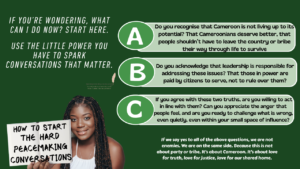
Tensions are rising. And while I can’t call that a win, I can say it’s understandable, maybe even necessary. Before sharing this, I had to pray. Because this isn’t about me, it’s about sharing a lesson that’s been growing in my heart for the past year, one that the Holy Spirit has been teaching me through my anger, confusion, and faith. Last year, when Trump won, I was deeply angry, less about the outcome and more about what it revealed about humanity, and the way Christianity was being warped to legitimise a regression into hate. But God showed me the unexpected benefit in this: some things have to come into the light before they can be healed.What we’ve been witnessing, the rise of the far right, the open displays of racism, sexism, and intolerance, etc., these things didn’t appear out of nowhere. They were already there, festering in silence. Those who called themselves “liberal” or “progressive” thought they were winning, but were only louder, not more convincing. People’s minds weren’t changing; we had just learned how to drown out discomfort with better PR. And so, God helped me appreciate (not like nor enjoy) that injustice, hate, and hypocrisy are rising to the surface. It is not only proof that the world is falling apart, but also proof that the sickness is finally being exposed. Because sometimes, the only way to confront darkness is to let it come into the open. You can’t cleanse what you won’t name. I am sharing this lesson from the past year, because I find it particularly valuable to where we are now in Cameroon. Many are upset by the unrest and are “praying for peace”, but too often what we mean is silence, a return to comfort. Because peace without justice is just silence. It’s the quiet that comes from people being too afraid or too exhausted to speak. That’s why I’ve stopped praying for “peace” in the shallow sense. Too often, when we say Father, give us peace, what we really mean is make it quiet again. We want normal, even if “normal” was rotting underneath. But real peace is not quietness; it’s justice restored. The Bible says, Blessed are the peacemakers (Mathew 5:9). Peacemaking is not passive. It’s work. It requires strategy and courage. You can’t make peace unless you first admit there isn’t any. That means naming what’s broken, confronting what festers, and having the uncomfortable conversations that move us toward healing. So if you’re praying for peace, pray also to become a peacemaker, someone willing to have hard conversations, to think critically, to challenge what’s wrong even in your own home. Because peace won’t come from the top down; it starts with us.As I said yesterday, until we start calling out our friends, our uncles, our chiefs, and the elders in our own circles who benefit from upholding this system, nothing will change. This isn’t just about one man or a few men up there. The system survives because of what we have accepted, played into, and kept silent about. And I know many people are thinking they are powerless today, after the declaration of those results and with the spread of violence. But that’s a lie. A dangerous one. That’s one of the biggest lies we’ve been sold. My favourite Alice Walker quote says: “The most common way people give up their power is by thinking they don’t have any.” You do have power.If you’re raising a child to be civic conscious and to shun ethnic bias and other divisions, you’re shaping a future mind, that’s power.If you can speak up, write, and influence others with your platform, that’s power.Even having difficult conversations is a power. You have power over what you allow to slide unchallenged in your circle. You only lose your power when you say, “What’s the point? Nothing will change.” Many of us are tired and resigned right now, but we still have some power. I’m inviting us to start from where we are. Talk to the people closest to you, especially the ones who think differently, who still believe the system works. You have the power to engage those you disagree with, who you know are complicit in keeping us all down, or who don’t know better. Let’s address our own, speak to that uncle who got you your job through his connections with the party.Address that elder in your church who excuses their participation in this system. Let’s have an honest conversation with the colleague who says, “That’s just how Cameroon is”? This is not about attacking anyone. It’s about peacemaking, the uncomfortable, confrontational and patient work of helping people see differently and finding common ground. Because if we are honest, the greatest evil this government has perfected is divide and rule.Francophones against Anglophones.North-West against South-West.Christians against Muslims.Each of us is taught to see the other as the problem. But the truth is, this system harms us all. Even those in power — they, too, are trapped in a machine that feeds them crumbs while robbing everyone of dignity. We need to acknowledge this division for what it is, a tool of control, and find our way back to common ground. So if you’re wondering, what can I do? Start there.Use the little power you have to spark conversations that matter. There’s a technique I use with my students when teaching feminism, and it works for complex topics too: ask questions that make people think. If you know someone who supports the current regime, talk to them. Pray first (genuinely) so you speak with calm and compassion, not anger. Then ask: 1. Do you recognise that Cameroon is not living up to its potential?That most Cameroonians deserve better, that people shouldn’t have to leave the country or bribe their way through life to survive? 2. Do you acknowledge that leadership is responsible for addressing these issues?That those in power are paid by citizens to serve, not to rule over them? 3. If you agree
On post-elections Cameroon, and the Dangerous Death of Hope
Years ago, I began using the hashtag #MakeCameroonHopefulAgain. People thought it was a mockery of “#MakeAmericaGreatAgain”. It wasn’t. It came to mind as I thought of what we needed most. We need hope. I write this having just concluded a conversation with a friend where we discussed our sadness at another sham of an election in Cameroon and the violence already spreading. Something she said reminded me of a video I saw recently, one that explained why Gaza matters so much. Now, I know many Africans hear that and go, “Abeg, we have enough problems of our own; Congo, Sudan, Cameroon…” And they’re right. Others counter that the world isn’t even talking about those places with the same energy, and they’re right, too. Both thoughts are valid. But that video said something that struck me and has made me appreciate Africans like Zukiswa Wanner taking Gaza seriously (read about her experience HERE). There’s something about Gaza that demands attention, not because it’s more tragic than others, but because it exposes one of humanity’s most dangerous delusions. That delusion is the belief in the perfect victim. We’ve been taught, through religion, through moral philosophy, through the selective histories on Martin Luther King Jr and Mandela, that if we are peaceful enough, patient enough, and innocent enough, the world will recognise our suffering. That if we document the injustice, appeal to conscience, show the evidence, people will do better once they know better. Gaza is a brutal contradiction of that belief. We have seen everything: the bombed hospitals, the dead children, the journalists silenced, the white allies targeted, and the churches and mosques alike destroyed. It has been filmed, documented, and verified. All the UN agencies have called it a genocide. And yet, the killing continues. If “doing everything right” still ends in annihilation, what happens to people’s faith in peace, in reason, in humanity? I think back to Nigeria in 2020, and the way I felt after the Lekki Toll Gate massacre. We watched that live, too. We saw the lights go out, and the soldiers open fire on young people singing the anthem. The #EndSARS protests may have been violent in many places, but in Lekki, where most are middle- to upper-class, there was a DJ playing music. That’s as peaceful as an African protest can get. It seems like a very resolute party with young people singing, and mostly on their phones. They still got shot by the army, the same army they fund through their taxes. And years later, one of the men responsible is now the president of Nigeria. What message does that send? It didn’t matter that we knew; it didn’t matter that journalists printed evidence of his other crimes. It says: evidence doesn’t matter. Some people can get away with it. Just as their guilt doesn’t hang them, so too, your innocence doesn’t save you. Do you see the issue? The danger? Now, let’s think of Cameroon. If we think critically, we have already seen this thing play out in Cameroon, with a horrific end. The ongoing Anglophone crisis didn’t start with what we now call “Amba”. Before that, there were teachers and lawyers, peaceful, moderate people asking to be heard and for legal systems to be respected and issues addressed. And they were mocked, arrested, and belittled. When you crush the moderates, when you show that peaceful protest and following due process means nothing, you create a power vacuum. And in that vacuum, beasts rise. That is how we now have the scourge of Amba and a people turned on themselves. People keep saying the Anglophone crisis became violent because guns got into the wrong people’s hands or drugs spread among the youth. But no, before the guns and the drugs, hope left their hearts. When people no longer believe that the peaceful path works, when they no longer trust that justice or accountability exist, what else do you expect them to become? You kill the last bit of hope people have in dialogue when you turn dialogue into a bureaucratic charade (see the 2019 “national dialogue”) and use peace marches for your selfish ends. And once hope dies, people devolve. They stop caring. And here we are, seeing the same thing happen again: people’s cries are being ignored in other regions, and the evidence the masses put together is being ignored. We have seen videos of electoral fraud with no accountability. If we keep letting that happen, if we keep mocking peaceful efforts, silencing reason, and ignoring evidence, then we are the ones feeding the beast. As someone who witnessed the crisis go haywire and spoke up against it from the start, this is a perilous spiral. You cannot control the beast; it turns on anyone and everyone. I’m writing this as a follow-up to a video I shared earlier to make a note, because I am noticing a pattern. People are losing faith in processes, in justice, in peace. And when hope goes, violence rises. In fact, violence has risen, and we must acknowledge that it is not because certain people are just violent, but rather it is evidence of increasing despair. Despair is the beginning of chaos. So please, let’s not joke with the widespread expressions of despair. Protect hope.It’s not sentimental, it’s imperative for survival. Before guns get into more hands, let’s make sure hope hasn’t left their hearts.
Somewhere between Belief & Understanding: Lessons from wrestling with God at 36
I recently completed my 36th turn around the sun and I would like to share what has been the lesson of this age for me. Before I begin though, I must preface this by saying that I believe in God. Belief aside, even my logic affirms that there is a God. Still, I acknowledge that the questions that follow; Who’s God? How good is God? etc. are valid, but the existence of a supreme being has never been in doubt for me. I’ve had personal encounters, a life filled with testimonies, and the reasoning that there is simply too much intricacy and beauty in creation for there not to be a divine being. I not only believe in God, I am a Christian. Some might argue that’s because I was born into a Christian family, and perhaps they’re partly right; maybe if I were born elsewhere, I’d have clung to another faith. But it isn’t my family that made me Christian. They set the stage, but it was my own encounter with God that sealed it. I gave my life to Christ after a suicide attempt, so my journey is deeply personal (read conversion story here). This year, however, has been one of the most trying for my faith. It has pushed me to wrestle with belief and logic in ways I hadn’t before. In earlier years, I’ve had doubts, yes, but they were mostly tied to depression, suicidal ideation, or difficult circumstances, not solely intellectual questioning. The last time I questioned God this deeply was in 2021, when suicidal thoughts resurfaced after years of dormancy. It was painful to want to die while watching others who wanted to live lose their lives. In 2022, things began to shift. Therapy and a strong Christian sisterhood helped me heal. That season led me to reaffirm my vows to Christ through baptism in August 2022. I wrote about here it at the time. My promise then was simple: Lord, I won’t attempt to take my life again. I’m surrendering the life to you who obviously wants to keep me here. Help me appreciate that, see value in being here and to live for You. Since then, my faith hasn’t been perfect, but it’s been steady, until recently. Between late 2024 and now, I’ve been shaken by what I’ve witnessed in the global Christian community, particularly the rise of American Christian nationalism. Because American culture dominates global media, its distorted theology spreads everywhere. Seeing Christians justify injustice, inequality, and blind leadership in God’s name has been heartbreaking. I found myself asking: Am I worshipping a God of injustice? In those moments, I’ve had to remind myself of who God truly is- based on my own encounters, not others’ interpretations. I’ve had to pray: God, please defend Your name, because what I see doesn’t make sense. Thankfully, God is not threatened by my questions. He welcomes them. And I’ve been blessed with a church home (linked here) and a pastor who encourages honest questioning, and a small circle of Christian sisters who help me stay grounded. Without them, I might have lost my sanity amidst all the twisted rhetoric. Still, I often find myself overwhelmed, looking at the state of the world and thinking, Lord, just blow the trumpet, send another flood and start over (or perhaps not at all), because this seems beyond saving. Recently, I was reminded of a lesson from someone I dearly respect, though I’ve since been disappointed by their alignment with the kind of toxic Christian rhetoric I now resist. A few years ago, we did a peer-review exercise naming each other’s strengths and weaknesses. She told me I had a tendency to question authority too much. At the time, I thought she was using the exercise to criticize me (that was ego), but even then I couldn’t deny she was right. She explained that I often refuse advice from people who haven’t been through what I’m facing, and that I believe I know what’s best for myself. Looking back, I see truth in that. I do question authority. I need people to prove they’re qualified to lead or advise me. That trait has followed me since childhood, my mother used to say I was too strong-willed, too stubborn, that we couldn’t both lead the household. Through therapy, I’ve come to understand where that comes from. It’s a response to being failed by authority figures; parents, elders, people who should have known better but didn’t. When authority fails you repeatedly, you learn to save yourself. You start thinking, If not for God and me, I wouldn’t still be here. That breeds self-reliance and skepticism of leadership. But in African society, that attitude is unsettling. Age, titles, and seniority often demand obedience. People expect you to follow simply because they hold a position. But for me, it doesn’t work that way. I’ve been my own father and mother for so long that I can’t just hand over that trust blindly. Still, I’m learning that this trait, that is- questioning authority, is both a gift and a trauma response. It protects me from blind submission, but it can also hinder faith and trust. God is teaching me balance: to discern when questioning is wisdom and when obedience is necessary. I recently watched a short clip that illustrated this perfectly. A father tells his child to move away from a package on their doorstep without explanation. The child obeys immediately, they soon find out that the box contains explosives. At the time, even the father didn’t know. He just suspected and at his command the child respected. Someone commented, “This is why learning obedience matters. You can question later, but sometimes, questioning too soon can cost your life.” That struck me. I’ve always been the child who asks why before acting. But that story reminded me that there’s a time for questioning and a time for trust. Sometimes, I just need to obey first and seek understanding afterward. That’s what God
Earlier This Year, I Was Asked About Cameroon’s Politics. Here’s What I Said…
In January of this year, I was invited by Line Sidonie Talla Mafotsing to share my reflections on Cameroon’s political culture, our history of leadership, and what lies ahead as the country prepares for elections. Unfortunately, it appears that she can no longer publish the piece for which I was interviewed. Nonetheless, I remembered the conversation and how I spoke candidly about what we have normalised as a nation, the muted sense of agency many of us feel, and much more. I’ve decided to publish some of the transcript here on my blog because the interview gave me space to think more deeply about history, memory, silence, and the guardrails we must build if we want change to mean more than just a new face at the top. And as we head into the month where we’ll be seeing yet another (sham) of an election. These words are all I have for now.
Musings on the Cost of Caring… and the need to unlearn busyness (Aug 2025)
They say it costs nothing to be kind. But it does. It costs a lot. I can’t only be kind with words. I have to be kind with actions. I have to be kind with my time. I have to be kind with my energy. And all of those cost something. Attending a child’s birthday party means I need money for transport, I need money for a gift, and I need the well-being to show up and actually be present. Even just giving someone a smile requires that I myself am okay. How do I smile when I can’t afford healthcare? How do I stand up to injustice when I’m already exhausted, working three jobs just to survive? Kindness costs. Caring costs. Humanity costs. And those in power know it. They have always known it. They bank on it. They keep building on systems of inequality because nobody interrupts them. The people who might have disrupted it before us were busy trying to survive. Just like we are busy now, and because we’re busy now, they will keep accumulating, and it will get worse in the future. Today we decry the glaring inequalities with the wealthiest 1% owning almost more than half the world does, but Elon didn’t get rich today, he was given the tools generations ago. These billionaires had the systems already in place, and because nobody stopped them then, we can’t stop them now. Humanity costs. And you know what? Upon reflection, I believe the greatest evil, the most significant threat to humanity, isn’t even the billionaires or the politicians. It’s our busyness. That’s the real enemy. It’s the way capitalism has cultivated a culture of individualism, where we’re constantly occupied and constantly trying to survive. Because as much as I want to help, I can’t help when I myself need help. So people postpone caring until it’s convenient. We postpone showing up at protests because we have to clock in at work. We postpone resisting oppression because it’s hitting someone else first, not us. We stay busy until it comes knocking directly on our door. Our occupations are the biggest threat to our humanity. And they know this. They know we cannot afford to care in a capitalist system, so they keep us anxious, they keep us hustling, they keep us busy. I remember one time I was in a clando from Buea to Douala. The driver got stopped, as usual, by gendarmes looking for a bribe. They started nitpicking at his papers. He had already paid money at so many stops that day, and he got angry. He said, “How much do I even make on this route if every time I pass, I give you something?” He refused. He was furious. But the gendarmes just stood there, waiting. And one by one, passengers started getting out of the car. They didn’t want to be delayed. They didn’t want trouble. And I understood them. I was quiet at first. But then I saw the gendarmes watching, amused, knowing the driver would eventually cave in, because without passengers, he’d lose everything. And I thought to myself: this is exactly how oppression works. They bank on our time, our impatience, our busyness. That day I decided to stay. I stayed in the car. Just one other passenger and I did so. And I said to myself, I’ll try to cover the cost of one other passenger who left, I’d pay for that seat, so the driver wouldn’t lose everything. The money was a sacrifice, but the look on that man’s face… I’ve never forgotten it. I recall tweeting about it at the time. He needed our presence so that it wouldn’t look like his defiance was madness. That day taught me that resistance requires time. Resistance requires forfeiting comfort. It requires staying put when it would be easier to leave. And not everyone can afford that. It reminded me of another moment, in 2017, during the protests at the University of Buea. In a meeting, the administrators were giving the Vice Chancellor their account of what had happened. They were blaming the students, blaming ethnic groups, twisting the truth. I sat there listening, afraid. And then I opened my mouth. I said, “That is not what happened.” I corrected the story. My heart was pounding. I was so afraid that I secretly called a friend on WhatsApp and pressed record so there would be proof of what I said. Later, I told my godmother about it, and she said something I will never forget: “That was a privilege.” And she was right. I was young, single, no children, no dependents. If I lost my job, I could try finding another one. But for my colleagues with families to feed, parents depending on them, the cost of courage was too high. It wasn’t that they didn’t care. It was that they couldn’t afford to care. That is the reality of capitalism. That’s the reality of our world. Life doesn’t give us margin. You may care deeply about Palestine or Congo or Sudan, but that doesn’t mean you can sacrifice your child’s school fees for the cause. You may want to protest, but you can’t risk losing your job. You may want to speak truth to power, but you know it won’t only cost you; it’ll cost everyone who depends on you. And so, some people fight from within the system, while others choose to leave and love their country from afar. And I’ve learned not to judge either choice, because both come from the same truth: humanity costs, and not everyone can pay. But here’s the part that scares me the most. The powerful know this. They count on it. They count on our busyness, our fatigue, our survival. They count on us not having the privilege to resist. And as long as they can keep us in that state, they will continue to win. So when people say kindness costs nothing, I shake my head. No.
Musings on Love, Faith, and the Daily Call to Choose
So here’s what I’ve been musing about lately… We often hear it said: Love is a choice. Increasingly, this message is gaining traction among my generation. We’re moving away from the idea that love is just a feeling. I think we now know better that it’s not the butterfly-infused infatuation we grew up watching on TV. Sure, feelings kick things off. You’re drawn to someone, you click with a friend, you enjoy being around them. But staying in love? Staying connected? That requires a daily, deliberate choice. You wake up and realise you haven’t spoken to someone you love in a while. You could carry on with your day and let the silence stretch further. Or you could make the effort. Reach out. Send that message. Because love means choosing to show up for your people, even when it’s inconvenient, even when your instinct is to retreat and choose yourself, or be selfish and think “why didn’t they write me first?”. Sometimes the choice is easy: you miss them, you’re craving intimacy, they’re giving you what you want. But other times? It’s messy. Sometimes love requires you to give something up, do something uncomfortable, or hold space for hard conversations. Whether it’s your partner, your children, your friends—love is wiping snotty noses, waking up early, showing up when you’d rather stay in bed. It’s joining parent WhatsApp groups and making small talk with other adults when you’d rather be doing literally anything else. Love is action. It’s an effort. It’s a decision. Now, what prompted all this reflection wasn’t just romantic or familial love; it was a conviction. A spiritual one. A reminder of the fact that I made a choice a few years ago and how it’s one I need to recommit to in this season. That reminder came through a whispered statement: ‘Love is a choice, and the same applies to faith.’ Like, yes, if loving people whom you can see is a choice, how much more is loving a God you can’t see a choice? To love God is to wake up each morning and choose to believe. To believe He’s good, even when the world doesn’t look like it. To choose to trust in a Bible that, let’s be honest, raises many questions. A Bible, we know, wasn’t lowered from heaven in one clean piece, but written and compiled by men, shaped by councils and omissions ( who knows that the books hidden in vaults, sidelined by institutions like the Vatican, said, books no one ever told us how or why they were excluded). And yet. This same Bible has spoken to my spirit in a way that nothing else has. Its words do something. Not always immediately. Not always conveniently. But deeply. They manifest differently. They hold power. They’ve comforted me, corrected me, and carried me through seasons where no one else’s words could. Even with all its human fingerprints, all the baggage it carries from being used to justify slavery, colonisation, patriarchy, racism and more, it also carries something sacred. Something that can’t quite be explained but can be felt. It tells the story of a God who has pursued humanity with relentless grace. A God who loved us enough to become one of us. A God who laid Himself down for us. You see, it’s not a once-and-done thing. Choosing God isn’t something you do once when you “give your life to Christ.” It’s not a one-time conversion. It’s daily. It’s every moment.One of my favourite C.S. Lewis quotes goes: Relying on God has to begin all over again every day as if nothing had yet been done. Yes, the Holy Spirit is a helper. A counsellor. A transformer. He’s all those things. But let’s be honest, you still have to make a choice. You choose whether to heed His conviction. You choose whether to seek Him. You choose whether to be comforted by Him or by food, sex, shopping, work, etc. And choosing Him isn’t always convenient. It’s like choosing your spouse even when they annoy you, or when they’re no longer exciting. You made a vow. So when you stop choosing them, you’re breaking your vow. Same with God. If we framed it like that—like not choosing Him is breaking your vow—I think some of us would rethink the way we move. We’d check ourselves. We’d understand what this walk actually requires. Because listen, there are parts of this faith that are uncomfortable. Things that don’t make sense. Things you’ll never be able to explain or reconcile. That’s why it’s called faith. It’s not logic. If it were logical, we wouldn’t need faith. Some days, the only thing I can say for sure is that I’m choosing. Like how kids believe in Santa Claus. I’m just choosing. And today, as the Holy Spirit convicted me and reminded me of this, I’m saying it out loud: You made a choice, Monique. Are you going to keep choosing? You made that choice because you’ve experienced God. You’ve had encounters. You’ve seen His works. And though you’ve overthought this (because you always do), you landed here rationally—you’ve examined other religions, you’ve done the mental work, and this is the faith that makes the most sense to your spirit, that speaks love and grace the way no other one does. So yeah. That’s what I’m reminding myself today: It’s a choice. May the Holy Spirit help us to keep choosing Him. That’s all I’ve got for now.