Skip to content

Monique Kwachou

Welcome to my digital corner of the web. This is a space for thinking, writing, remembering, and speaking in public. Whether you are here to read, research, or collaborate, the door is open.

On Recap Culture and the importance of Having your Own KPIs

Life Lessons & Rambling

End-of-year reflections aren’t new. We’ve always done them, some of us in journals, some of us at “crossover nights on New Year’s Eve, most of us around an impending birthday… when the year is slipping away, or you’re becoming older, you suddenly feel an itch to reflect. I think it’s a sign of us being intelligent beings. “I think, therefore I am”, or whatever Descartes said. But these days? Reflection has become… loud.In the last few years, with the advent of things like Spotify Wrapped and other recap features, our end-of-year reflective practices have morphed from introspective moments into a public sport. Our apps now tally up what we listened to, where we spent money, what we read, and who we followed, then turn it into colourful graphics for us to share. It’s everywhere. It’s visible. And as a result, it’s competitive. You might have heard the Instagram reel sound used to capture a full year in pictures: January, February, March, etc. (I have wanted to use that reel sound so badly!) Or you may have seen people recapping all the places they went to over the course of the year and wished that it were you. The truth is, we all know comparison is a thief of joy, but it’s hard not to compare when you have this onslaught of everyone else’s highlights in your face each time you open social media, and you’re all too familiar with your own failings. So what do we do? How do we check out of this competition none of us signed up for? I haven’t come to tell you to ‘just don’t compare’. Rather, I’m here to share a lesson the Holy Spirit taught me in 2023 when I was feeling particularly disappointed in myself for not having achieved as much as a colleague in the Cameroonian CSO space. They had been racking in the awards, and I was about to take a gap year because I was burned out, but I had achieved way less than they had. Then the Holy Spirit convicted me: Were those awards my goals? Were they my “Key Performance Indicators” (KPIs as we say in corporate, lol)? If so, what does that say of me, and if not, why do I think my failure is defined by not having had them? That reflection, prompted by the Holy Spirit, led me to have two conversations with friends Juisi and Valerie Viban. I must say, I didn’t feel like a ‘success’ after that; the reflection forced me to clearly define what being successful in youth work meant to me. And even by my own self-defined KPIs, I knew I could have done better. BUT now, I wasn’t feeling unsuccessful for the wrong reasons. That experience has come to mind several times since then. It keeps envy and discontent at bay often, because when you know what you really want, when you have interrogated your why, and defined for yourself what happiness or success is. What is meaningful to you and not because you think you should have it or because it is expected of you… When you have those personalised definitions, contextualised for your phase of life? It’s all easier to take in. In an older blog post I wrote entitled “Want to have a successful year? How are you defining success?”, I reflect on one of my favourite poems (or is it merely a quote?) that I recently learned is wrongly attributed to Ralph Waldo Emerson but is really the work of Bessie Anderson Stanley. See the image below of it: I love that piece dearly for the simple way it highlights what truly matters. Notice it doesn’t say achieve everything on your five-year plan. It doesn’t say win prizes or go viral. Because if you were to die next week, wouldn’t it matter more that you contributed something meaningful to society, made those who look up to you (children) smile, and created a handful of happy moments? It doesn’t even say be impressive.It just says: contribute, be affirmed by people of substance (not everyone), bring joy where you can. That is enough. Often, when we look back and write off a year as bad, or when setting goals for the next year. I feel the difficulty itself is realising that we don’t even know what we mean when we say we want a “successful” year. And truth be told, most of us don’t stop to ask that question.We inherit definitions from society, from childhood, from social media… and we start running with them. But it is necessary, imperative, to define success for yourself and to interrogate why you’ve defined it that way. If you don’t, you end up chasing a finish line that isn’t even yours. Or chasing a goal post that keeps moving every time you near it. So, as you look at recaps and evaluate how this year went, think of the poem “What Is Success” and remember that the little things matter: Did you laugh? (Even if it was at TikToks and memes.) Did you bring a bit of joy to someone, anyone at all, a child, a friend, a stranger? Then they have lived easier because you were alive in 2025. Did you appreciate nature, beauty, or a moment of peace? Did you leave even one corner of the world better than you found it? According to that poem, many of us have succeeded without knowing it because these are not things that get awards. Nobody gives you a fellowship for surviving a hard year. There is no prize for emotional labour or resilience. No app will tally how many burdens you quietly carried or how many small kindnesses you offered. And yet, that is success.Maybe you didn’t win anything this year, but you made someone feel safe.Maybe you didn’t hit your goals, but you grew.Maybe the year stretched you, but you didn’t break your principles…Maybe you laughed more than last year.Maybe you left somebody better. If that isn’t success, then
December 19, 2025 / 0 Comments
read more

Somewhere between Belief & Understanding: Lessons from wrestling with God at 36

About My Faith

I recently completed my 36th turn around the sun and I would like to share what has been the lesson of this age for me. Before I begin though, I must preface this by saying that I believe in God. Belief aside, even my logic affirms that there is a God. Still, I acknowledge that the questions that follow; Who’s God? How good is God? etc. are valid, but the existence of a supreme being has never been in doubt for me. I’ve had personal encounters, a life filled with testimonies, and the reasoning that there is simply too much intricacy and beauty in creation for there not to be a divine being. I not only believe in God, I am a Christian. Some might argue that’s because I was born into a Christian family, and perhaps they’re partly right; maybe if I were born elsewhere, I’d have clung to another faith. But it isn’t my family that made me Christian. They set the stage, but it was my own encounter with God that sealed it. I gave my life to Christ after a suicide attempt, so my journey is deeply personal (read conversion story here). This year, however, has been one of the most trying for my faith. It has pushed me to wrestle with belief and logic in ways I hadn’t before. In earlier years, I’ve had doubts, yes, but they were mostly tied to depression, suicidal ideation, or difficult circumstances, not solely intellectual questioning. The last time I questioned God this deeply was in 2021, when suicidal thoughts resurfaced after years of dormancy. It was painful to want to die while watching others who wanted to live lose their lives. In 2022, things began to shift. Therapy and a strong Christian sisterhood helped me heal. That season led me to reaffirm my vows to Christ through baptism in August 2022. I wrote about here it at the time. My promise then was simple: Lord, I won’t attempt to take my life again. I’m surrendering the life to you who obviously wants to keep me here. Help me appreciate that, see value in being here and to live for You. Since then, my faith hasn’t been perfect, but it’s been steady, until recently. Between late 2024 and now, I’ve been shaken by what I’ve witnessed in the global Christian community, particularly the rise of American Christian nationalism. Because American culture dominates global media, its distorted theology spreads everywhere. Seeing Christians justify injustice, inequality, and blind leadership in God’s name has been heartbreaking. I found myself asking: Am I worshipping a God of injustice? In those moments, I’ve had to remind myself of who God truly is- based on my own encounters, not others’ interpretations. I’ve had to pray: God, please defend Your name, because what I see doesn’t make sense. Thankfully, God is not threatened by my questions. He welcomes them. And I’ve been blessed with a church home (linked here) and a pastor who encourages honest questioning, and a small circle of Christian sisters who help me stay grounded. Without them, I might have lost my sanity amidst all the twisted rhetoric. Still, I often find myself overwhelmed, looking at the state of the world and thinking, Lord, just blow the trumpet, send another flood and start over (or perhaps not at all), because this seems beyond saving. Recently, I was reminded of a lesson from someone I dearly respect, though I’ve since been disappointed by their alignment with the kind of toxic Christian rhetoric I now resist. A few years ago, we did a peer-review exercise naming each other’s strengths and weaknesses. She told me I had a tendency to question authority too much. At the time, I thought she was using the exercise to criticize me (that was ego), but even then I couldn’t deny she was right. She explained that I often refuse advice from people who haven’t been through what I’m facing, and that I believe I know what’s best for myself. Looking back, I see truth in that. I do question authority. I need people to prove they’re qualified to lead or advise me. That trait has followed me since childhood, my mother used to say I was too strong-willed, too stubborn, that we couldn’t both lead the household. Through therapy, I’ve come to understand where that comes from. It’s a response to being failed by authority figures; parents, elders, people who should have known better but didn’t. When authority fails you repeatedly, you learn to save yourself. You start thinking, If not for God and me, I wouldn’t still be here. That breeds self-reliance and skepticism of leadership. But in African society, that attitude is unsettling. Age, titles, and seniority often demand obedience. People expect you to follow simply because they hold a position. But for me, it doesn’t work that way. I’ve been my own father and mother for so long that I can’t just hand over that trust blindly. Still, I’m learning that this trait, that is- questioning authority, is both a gift and a trauma response. It protects me from blind submission, but it can also hinder faith and trust. God is teaching me balance: to discern when questioning is wisdom and when obedience is necessary. I recently watched a short clip that illustrated this perfectly. A father tells his child to move away from a package on their doorstep without explanation. The child obeys immediately, they soon find out that the box contains explosives. At the time, even the father didn’t know. He just suspected and at his command the child respected. Someone commented, “This is why learning obedience matters. You can question later, but sometimes, questioning too soon can cost your life.” That struck me. I’ve always been the child who asks why before acting. But that story reminded me that there’s a time for questioning and a time for trust. Sometimes, I just need to obey first and seek understanding afterward. That’s what God

October 20, 2025 / 2 Comments
read more

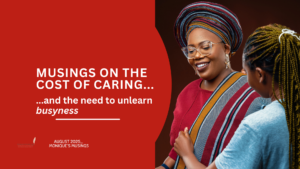
Musings on the Cost of Caring… and the need to unlearn busyness (Aug 2025)

Career Journey Reflections,  Feminist Rants,  Life Lessons & Rambling,  Socio-political Commentary on Cameroon

They say it costs nothing to be kind. But it does. It costs a lot. I can’t only be kind with words. I have to be kind with actions. I have to be kind with my time. I have to be kind with my energy. And all of those cost something. Attending a child’s birthday party means I need money for transport, I need money for a gift, and I need the well-being to show up and actually be present. Even just giving someone a smile requires that I myself am okay. How do I smile when I can’t afford healthcare? How do I stand up to injustice when I’m already exhausted, working three jobs just to survive? Kindness costs. Caring costs. Humanity costs. And those in power know it. They have always known it. They bank on it. They keep building on systems of inequality because nobody interrupts them. The people who might have disrupted it before us were busy trying to survive. Just like we are busy now, and because we’re busy now, they will keep accumulating, and it will get worse in the future. Today we decry the glaring inequalities with the wealthiest 1% owning almost more than half the world does, but Elon didn’t get rich today, he was given the tools generations ago. These billionaires had the systems already in place, and because nobody stopped them then, we can’t stop them now. Humanity costs. And you know what? Upon reflection, I believe the greatest evil, the most significant threat to humanity, isn’t even the billionaires or the politicians. It’s our busyness. That’s the real enemy. It’s the way capitalism has cultivated a culture of individualism, where we’re constantly occupied and constantly trying to survive. Because as much as I want to help, I can’t help when I myself need help. So people postpone caring until it’s convenient. We postpone showing up at protests because we have to clock in at work. We postpone resisting oppression because it’s hitting someone else first, not us. We stay busy until it comes knocking directly on our door. Our occupations are the biggest threat to our humanity. And they know this. They know we cannot afford to care in a capitalist system, so they keep us anxious, they keep us hustling, they keep us busy. I remember one time I was in a clando from Buea to Douala. The driver got stopped, as usual, by gendarmes looking for a bribe. They started nitpicking at his papers. He had already paid money at so many stops that day, and he got angry. He said, “How much do I even make on this route if every time I pass, I give you something?” He refused. He was furious. But the gendarmes just stood there, waiting. And one by one, passengers started getting out of the car. They didn’t want to be delayed. They didn’t want trouble. And I understood them. I was quiet at first. But then I saw the gendarmes watching, amused, knowing the driver would eventually cave in, because without passengers, he’d lose everything. And I thought to myself: this is exactly how oppression works. They bank on our time, our impatience, our busyness. That day I decided to stay. I stayed in the car. Just one other passenger and I did so. And I said to myself, I’ll try to cover the cost of one other passenger who left, I’d pay for that seat, so the driver wouldn’t lose everything. The money was a sacrifice, but the look on that man’s face… I’ve never forgotten it. I recall tweeting about it at the time. He needed our presence so that it wouldn’t look like his defiance was madness. That day taught me that resistance requires time. Resistance requires forfeiting comfort. It requires staying put when it would be easier to leave. And not everyone can afford that. It reminded me of another moment, in 2017, during the protests at the University of Buea. In a meeting, the administrators were giving the Vice Chancellor their account of what had happened. They were blaming the students, blaming ethnic groups, twisting the truth. I sat there listening, afraid. And then I opened my mouth. I said, “That is not what happened.” I corrected the story. My heart was pounding. I was so afraid that I secretly called a friend on WhatsApp and pressed record so there would be proof of what I said. Later, I told my godmother about it, and she said something I will never forget: “That was a privilege.” And she was right. I was young, single, no children, no dependents. If I lost my job, I could try finding another one. But for my colleagues with families to feed, parents depending on them, the cost of courage was too high. It wasn’t that they didn’t care. It was that they couldn’t afford to care. That is the reality of capitalism. That’s the reality of our world. Life doesn’t give us margin. You may care deeply about Palestine or Congo or Sudan, but that doesn’t mean you can sacrifice your child’s school fees for the cause. You may want to protest, but you can’t risk losing your job. You may want to speak truth to power, but you know it won’t only cost you; it’ll cost everyone who depends on you. And so, some people fight from within the system, while others choose to leave and love their country from afar. And I’ve learned not to judge either choice, because both come from the same truth: humanity costs, and not everyone can pay. But here’s the part that scares me the most. The powerful know this. They count on it. They count on our busyness, our fatigue, our survival. They count on us not having the privilege to resist. And as long as they can keep us in that state, they will continue to win. So when people say kindness costs nothing, I shake my head. No.

August 31, 2025 / 0 Comments
read more

Musings on Love, Faith, and the Daily Call to Choose

About My Faith,  Life Lessons & Rambling

So here’s what I’ve been musing about lately… We often hear it said: Love is a choice. Increasingly, this message is gaining traction among my generation. We’re moving away from the idea that love is just a feeling. I think we now know better that it’s not the butterfly-infused infatuation we grew up watching on TV. Sure, feelings kick things off. You’re drawn to someone, you click with a friend, you enjoy being around them. But staying in love? Staying connected? That requires a daily, deliberate choice. You wake up and realise you haven’t spoken to someone you love in a while. You could carry on with your day and let the silence stretch further. Or you could make the effort. Reach out. Send that message. Because love means choosing to show up for your people, even when it’s inconvenient, even when your instinct is to retreat and choose yourself, or be selfish and think “why didn’t they write me first?”. Sometimes the choice is easy: you miss them, you’re craving intimacy, they’re giving you what you want. But other times? It’s messy. Sometimes love requires you to give something up, do something uncomfortable, or hold space for hard conversations. Whether it’s your partner, your children, your friends—love is wiping snotty noses, waking up early, showing up when you’d rather stay in bed. It’s joining parent WhatsApp groups and making small talk with other adults when you’d rather be doing literally anything else. Love is action. It’s an effort. It’s a decision. Now, what prompted all this reflection wasn’t just romantic or familial love; it was a conviction. A spiritual one. A reminder of the fact that I made a choice a few years ago and how it’s one I need to recommit to in this season. That reminder came through a whispered statement: ‘Love is a choice, and the same applies to faith.’ Like, yes, if loving people whom you can see is a choice, how much more is loving a God you can’t see a choice? To love God is to wake up each morning and choose to believe. To believe He’s good, even when the world doesn’t look like it. To choose to trust in a Bible that, let’s be honest, raises many questions. A Bible, we know, wasn’t lowered from heaven in one clean piece, but written and compiled by men, shaped by councils and omissions ( who knows that the books hidden in vaults, sidelined by institutions like the Vatican, said, books no one ever told us how or why they were excluded). And yet. This same Bible has spoken to my spirit in a way that nothing else has. Its words do something. Not always immediately. Not always conveniently. But deeply. They manifest differently. They hold power. They’ve comforted me, corrected me, and carried me through seasons where no one else’s words could. Even with all its human fingerprints, all the baggage it carries from being used to justify slavery, colonisation, patriarchy, racism and more, it also carries something sacred. Something that can’t quite be explained but can be felt. It tells the story of a God who has pursued humanity with relentless grace. A God who loved us enough to become one of us. A God who laid Himself down for us. You see, it’s not a once-and-done thing. Choosing God isn’t something you do once when you “give your life to Christ.” It’s not a one-time conversion. It’s daily. It’s every moment.One of my favourite C.S. Lewis quotes goes: Relying on God has to begin all over again every day as if nothing had yet been done. Yes, the Holy Spirit is a helper. A counsellor. A transformer. He’s all those things. But let’s be honest, you still have to make a choice. You choose whether to heed His conviction. You choose whether to seek Him. You choose whether to be comforted by Him or by food, sex, shopping, work, etc. And choosing Him isn’t always convenient. It’s like choosing your spouse even when they annoy you, or when they’re no longer exciting. You made a vow. So when you stop choosing them, you’re breaking your vow. Same with God. If we framed it like that—like not choosing Him is breaking your vow—I think some of us would rethink the way we move. We’d check ourselves. We’d understand what this walk actually requires. Because listen, there are parts of this faith that are uncomfortable. Things that don’t make sense. Things you’ll never be able to explain or reconcile. That’s why it’s called faith. It’s not logic. If it were logical, we wouldn’t need faith. Some days, the only thing I can say for sure is that I’m choosing. Like how kids believe in Santa Claus. I’m just choosing. And today, as the Holy Spirit convicted me and reminded me of this, I’m saying it out loud: You made a choice, Monique. Are you going to keep choosing? You made that choice because you’ve experienced God. You’ve had encounters. You’ve seen His works. And though you’ve overthought this (because you always do), you landed here rationally—you’ve examined other religions, you’ve done the mental work, and this is the faith that makes the most sense to your spirit, that speaks love and grace the way no other one does. So yeah. That’s what I’m reminding myself today: It’s a choice. May the Holy Spirit help us to keep choosing Him. That’s all I’ve got for now.

July 9, 2025 / 0 Comments
read more

Because I did a THING! Booklaunch Vlog! (March 2025)

Poetry, Flash Fiction & Book Reviews,  Vlogs

Dearest Reader, So… I did a thing. After last year, I had to face the fact that I wasn’t really writing anymore, not in the way I used to. I was letting fear get in the way: fear that I wasn’t good enough, that the next thing I wrote had to be serious, had to be big— like a novel or my PhD monograph. Meanwhile, I was sitting on years of poems. Real feelings. Real moments. Just… sitting there. Then I travelled to the U.S., and blogged HERE about how that trip brought back a lot. It reminded me of all the dreams I had as a kid, before the burnout, before the pressure to be brilliant all the time. I met people living their dreams—big or small, loud or quiet—but trying to live fully. That experience made me realise I was playing small. And for what? So this year, I decided: I’m doing something for me. I’m checking one thing off my childhood dream list. I took the poetry I’ve been writing since I was 26, enlisted some incredible friends to help with the shortlisting, hired an editor, and worked with a project manager… and I made a book. I self-published a poetry collection. It’s called “O Jewa Ke Eng?” which means “what’s eating you up inside?”. The title comes from a tweet that went viral while I was doing my PhD in South Africa, and it inspired one of the poems in the book. Because that question, when asked honestly, can unlock so much. It really is about holding space for what we usually keep inside. And because I’m me, a teacher through and through, I couldn’t help making it interactive. I wanted this to be something you feel with me. So, the book invites you to colour how each poem made you feel using the emotion wheel. Then there’s a colour-by-number piece at the end that becomes your emotional summary. And yes, there are blank pages for you to talk back. Write. Doodle. Cry if you need to. This book is ours now. If you made it to the launch back in March, thank you from the bottom of my heart. The love in that room? Overwhelming. But if you couldn’t make it, I’ve got you. Below is the full video of the launch, so you can experience a bit of what we shared that day. Watch it. Feel it. Tell me what moved you. Oh, and there’s a surprise within (I’m officially a songwriter lol!) Let’s talk in the comments. P.S. You can get a copy of the book on Amazon (UK, U.S., EU) or via JollyLife Bookstore in Cameroon.

May 31, 2025 / 0 Comments
read more

What is Life Teaching You Now?

Life Lessons & Rambling

Here is another vlog where I discuss what I’m learning in this season of life; about taking the everyday mundane as what we’re living for, planning for death in addition to living like it is you’re last week, and realizing that your best version of yourself may not be who you were meant to be. Watch and let me know your thoughts, I would also love to hear from you. What is life teaching you now?

March 31, 2024 / 0 Comments
read more

2024 My Year Of No? (Dec 2023 Blog)

Career Journey Reflections,  Life Lessons & Rambling,  Uncategorized

It has become a tradition of mine to have a theme for the year; a word or phrase that speaks of my intention for the new chapter. It is not a resolution but a word that captures what I hope will be an undercurrent of my actions throughout the year. Still, I think this past year was my first ‘successful’ realization of a ‘thematic year’. Not because I ‘achieved a lot’ but because it was the most intentional I have been with a theme. See when I declared 2023 my Year of Self-Love, I outlined how I would take steps to finally love the body I’m in, to truly love myself. E.g. 1- Loving myself by doing things the self loves e.g taking swimming lessons. 2- Loving self by investing in mental health treatments more than ever. 3- Loving self by giving away all the clothes that no longer fit and getting new clothes that do. 4- Loving self by gifting myself the way I gift others, by asking for help and delegating what t I cannot do. 5- Loving self by getting to know the one who made me – God – and drawing myself worth from Him etc. The above are just a few ways I intentionally sought to live out the theme I declared, and to an extent, the year of self-love worked. I became better at the swimming I loved doing- even swan in the deep end for the first time, I entered a New Covenant with Yahweh last year, I bought myself a brand new phone for the first time last year, I even dared to remove the enlargement of my Boudoir shoot photo it’s in my bedroom but at least no longer hidden… Yet some things remain the same. At the junctures of my year of self-love, I hated myself as ever before or more than ever before. As much as I was proud of loving myself enough to openly ask for help, I still hated that I needed to keep asking for help. Another way my thematic practice was different this past year lies in the fact that this was the first year that I assessed the theme. I intentionally looked back at what I had been doing towards that theme and whether I could see changes or not. And perhaps because I did that reflection, I could appreciate that working on self-love as someone who struggles with that area cannot be limited to a year or any timeframe for that matter. The greatest success of the year of self-love therefore was coming to accept that this struggle might be never-ending; it took 30 years to internalize the reasons and ways I dishonor myself, and it won’t be healed in a year, no matter how much I do differently. It is also as a result of the above reflection that I can go into making a theme for this year more intentionally than ever. As we usher in a New Year and I declare a new theme for 2024, I am aware that the old theme has not been “done and dusted”. My declaration of this year as “my Year of No” is, in fact, an extension of last year’s theme of Year of Self-love. How so? This year, with this theme, I am declaring an intention to love myself better and more by doing less so I can heal. One thing that has come through clearly in the past years has been how burn-out, depression and years of pent-up issues all came ahead to break me between 2020 and 2022. However, I kept thinking I could just push through it, and try harder. So I have shamed myself for not being as I was before; as committed to goals, as disciplined, as attractive as talented etc. But shaming does nothing but fuel the depressive episodes. I think what finally got me to think differently was trying on the idea of a Year of No; when I first considered it everything in my being protested. Do I deserve a year of NO when the last 2-3 years have been my most unproductive? Shouldn’t I be trying to achieve goals, and check off to-do list items that have been languishing on my Google Keep for ages? But then I saw this quote: “You’ve been beating up yourself for years and it hasn’t worked, try giving yourself grace and see what happens”. As I have nothing to lose at this point, I think I’ll try the reverse psychology. I’m permitting myself to fail at doing and being it all. In fact, you can’t fail at what you were never meant to do: so this year I want to try having as little to nothing on the to-do list to shame myself for ‘failing’ at. I give myself permission to do nothing but hibernate. I want to rediscover reading for fun. What does a Year of No entail you might wonder? Well, in 2017, when I declared my Year of Yes, I said yes to every opportunity that came my way. I said yes to trying over and over again. I stopped limiting myself to what I wanted (e.g a distance learning PhD) and said yes to whatever I was offered. That was the season for that. This season is different and I must acknowledge that even if I don’t like it. So in this season, I’ll say more no’s or respond with not now, maybe later. I will avoid taking up any additional tasks; no more signing up for things and then asking God for the strength to do them. No more asking for more strength when the body has made it clear it wants to rest. This article gives a great idea of what declaring A Year of No may entail for others… This might sound counterintuitive. And I admit it reeks of privilege. Yet, I am willing to live out this privilege with gratitude. I have found I must question the desire

January 27, 2024 / 0 Comments
read more

Oct 2023: More Birthday Reflections

Life Lessons & Rambling,  Unlearning Series

It’s another October and my birthday has come to pass. I recall when I was turning 30, I wrote a blog post about how I am no longer adding things on a “to-be list”, but rather things I want to undo… I didn’t have the concept of ‘unlearning’ in my vocabulary or my mind yet. That blog seems a bit foretelling now. Perhaps we really should be careful with our declarations; since then I have been in a loop of unlearning. This year I officially checked off 34 and started the 35th trip around the sun. All I can think of is what I’d like to re-learn given all the unlearning I have done and continue to do. The truth is, I’ve been doing the bare minimum for the past two years; for the most part, I’ve just been trying to survive my own mind. I can hear someone say “Hmm na your own bare minimum this?” And the answer is yes. I know what I’m capable of, what I can do when I feel driven when I believe it matters, when I believe I matter… I’ve not done close to that in a while. Perhaps it’s the burnout from years of hardcore mode (actually, this is very likely it). But knowing you’re burned out doesn’t make you feel better about being unproductive. The past 2 years have been some of my most unproductive. I’m not saying this as a “humble brag”. I know some people won’t get it, and I know my sister-friends will be like “You’re too hard on yourself Monique” and perhaps they’re right, but I’m also thinking critically 🤷🏾‍♀️ And if I’m being very honest anything I’ve enjoyed from March 2021 till date is somehow the fruit of the work I did in my 20s. I’ve been saying ‘thank you’ to the version of Monique who did so much in her 20s that this version of Monique can get away with doing so little in her 30s. But it’s a bittersweet thank you because despite all that version did she couldn’t fix some major issues… And now 2 years out of my ‘top form’, I’m wondering: As I consider how much I have to be grateful to younger Monique, I am considering what I should be relearning as much as I unlearn. So that older Monique will be able to say similar “thanks” for the current version of me in future. Here’s my shortlist of things I must re-learn: 1. I must re-learn reading for fun of it. 2. I must re-learn imagination without restrictions; such as how it never bothered me that ever character in my favorite version of Cinderella was a different race. Such as how I loved watching “The Magic School Bus” 3. I must re-learn asking for help and expecting it to come 4. I must re-learn curiosity about who I am and who I want to be, what makes me fun 5. And I must re-learn the novelty of dreaming… asking myself again “who do I want to be when I grow up?” What made me lose these things, growing up? How then do I “grow down”?

December 26, 2023 / 0 Comments
read more

Nov 2023: Looking Back at the Year of Self-Love

Life Lessons & Rambling,  Vlogs

At the start of this year, I vowed to make this my year of self-love. I have struggled with self-esteem issues all my life and this year I got sick of it. For context, I was coming out of a long bout of clinical depression where I had regained a great deal of weight I lost and through therapy was finding that there were layers to the depressive feelings. The process of healing is often rough and hard and lonely- we don’t talk enough about that. I decided that something had to give this year. In this month’s vlog, I talk through the efforts made towards self-love and where I think I am now- in sum, still trying.

December 26, 2023 / 0 Comments
read more

Sept 2023: Healing My Writing Soul

Career Journey Reflections,  Life Lessons & Rambling,  Poetry, Flash Fiction & Book Reviews

A recently unlocked memory is of the day my O’ Level GCE results were read. The year was 2006, I had convinced my mom to let me go visit a friend who lived in Baffoussam. It was my first real trip away from home initiated by me. It helped that the said friend was our Senior prefect in school and hence they assumed she was a responsible friend LOL! Anyway, when my results were made known to my family, a plethora of congratulatory calls came in. In the course of one such call, my aunty asked me the age-old question “So what do you want to be when you grow up?” Monique opened her mouth and said ” I want to be a writer” LOL! Did I know what I was saying? I didn’t (ugh! I miss that hopeful naive me), I did however know that books were saving my sanity at that time. Books were giving me solace and places to escape and teaching me better about the world and other humans than my teachers… and so I wanted to be a writer, to create that escape for someone else. I have written about the development of myself as a writer elsewhere (see here) but that was before experiencing the Anglophone Crisis that helped me narrow down my writing voice and writing soul so-to-speak. That was also way before multiple experiences made my writing voice, soul and dreams shrivel up to near death. Like most things, gifts don’t die suddenly nor all at once; they weather away. In 2020, I wrote a poem about no longer being able to write- it sounds ironical I know- but it was me perceiving and reporting the weathering. The loss that was already happening. I wrote the above poems 3+ years into the Anglophone Crisis and 2+ years into a horrible ‘situationship’. Both experiences made me lose my faith in the power of words, my writing and writing in general. So many of my articles were on the Crisis and those who read them were not those who needed to, those who needed to read and be moved do not read. Similarly, so many of my poems were love poems for someone who read them but would still not be moved/understand enough to reciprocate, to love me back. So I stopped writing. After all, I thought, what good was bleeding in words when the people just watched you bleed like it was a sport you enjoyed playing? And was I even writing ‘right’ if it didn’t move people to action if it didn’t reach the right ears/eyes, win the heart I yearned for? No, I thought. And so I stopped. Several years later, I recognize that reaction as a trauma response and regret giving up my gift. Stopping had its consequences. That kind of thinking- that other people’s actions or inaction depended on how well I wrote or did not write- fed my already bad case of perfectionism. And so here I am with a book deal unable to write. Struggling to believe in the power of words again. Forcing myself to write blog posts even if they’re months late. I’m praying for the gift to return, hoping its like riding a bicycle or swimming- a skill your body remembers. This time, when I say “I want to be a writer”, I know what I’m talking about. I have a better ‘why’, so I pray the gift returns.

December 26, 2023 / 1 Comment
read more

Posts pagination

1 2 … 4 Next